
Genus Aesculus in Subfamily Hippocastanoideae
In botanical taxonomy, a genus (plural genera) is a rank used to group closely related species within a family. In the hierarchy, genus sits below family and above species.
Genera are defined by shared morphological, anatomical, and genetic characteristics (for example, features of flowers, fruits, seeds, or leaves) that indicate a close evolutionary relationship among the species they contain.
Each genus can include one or more species. Examples include Rosa (roses) and Solanum (nightshades, including tomato and eggplant).
Do you wish to read more about plant taxonomy? Click here!
Genus Description
Suggest a correction!Aesculus L. (family Sapindaceae) comprises approximately twelve species of deciduous trees commonly called horse chestnuts or buckeyes. The genus ranges across the temperate Northern Hemisphere, from eastern North America through Europe to East Asia, and its type species is Aesculus hippocastanum L. (APG IV, 2016; POWO, 2024). Modern classification merges the former Hippocastanaceae into Sapindaceae (WFO, 2024).
Species are large trees with opposite, palmately compound leaves bearing five to nine leaflets and small caducous stipules. Their inflorescences are large, terminal panicles (often thyrsoid) that hold numerous showy flowers. Each flower has five free petals, five sepals, five stamens, and a superior ovary usually divided into three to five chambers, each containing a single ovule. The fruit is a woody, often spiny capsule that dehisces to release a single large seed per locule (Miller et al., 2022).
The greatest species richness occurs in East Asia (China, Japan, Korea) where several endemic taxa occur, and in eastern North America (the buckeyes). A single species, A. californica, occupies western North America, while European representation is limited to A. hippocastanum and a few naturalized hybrids. Typical habitats are temperate deciduous or mixed forests, riverine corridors and moderate elevations up to 1 500 m, with most species favoring well‑drained, fertile soils (WFO, 2024; Edwards et al., 2019).
The conspicuous flowers attract a diverse suite of insects, especially bees and flies, facilitating entomophily. Fruit capsules dehisce at maturity, allowing seeds to fall by gravity or be carried short distances by water.
Recent phylogenies place Aesculus within the tribe Hippocastaneae of Sapindaceae, sister to other temperate members (Miller et al., 2022). While some taxonomists historically divided the genus into subgenera Aesculus (horse chestnuts) and Parryana (buckeyes), molecular data show these groups are intermingled, and most modern treatments treat them as informal clades (Miller et al., 2022; Edwards et al., 2019). Earlier authors occasionally recognized the buckeyes as a separate genus Parryana, but recent treatments retain a single, broadly circumscribed Aesculus (Miller et al., 2022; Edwards et al., 2019).
Many species are planted as ornamental shade trees; A. hippocastanum and hybrids such as A. × carnea are common in parks and streets. The wood is hard but not commercially important, and the genus is not a major timber source. Introduced taxa occasionally naturalize, but none are considered serious weeds.
Certain Asian taxa, notably A. chinensis, are threatened by habitat loss and overharvest, highlighting a need for ex situ conservation and genetic studies. Future research should clarify species limits and climate‑change vulnerability to guide effective protection.
-
Aesculus × bushii (C.K.Schneid.)
-
Aesculus × hybrida (DC.)
-
Aesculus × marylandica (Booth ex Dippel)
-
Aesculus × mutabilis ((Spach) Scheele)
-
Aesculus assamica (Griff.)
-
Aesculus californica ((Spach) Nutt.)
-
Aesculus chinensis (Bunge)
1 -
Aesculus flava (Sol.)
-
Aesculus glabra (Willd.)
1 -
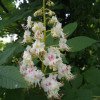
Aesculus hippocastanum (L.)
-
Aesculus indica ((Wall. ex Cambess.) Hook.)
1 -
Aesculus neglecta (Lindl.)
-
Aesculus parryi (A.Gray)
-
Aesculus parviflora (Walter)
-
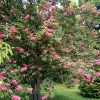
Aesculus pavia (L.)
1 -
Aesculus sylvatica (W.Bartram)
-
Aesculus tsiangii (Hu & W.P.Fang)
-
Aesculus turbinata (Blume)
-
Aesculus wangii (Hu)
1