
Genus Forsythia in Family Oleaceae
In botanical taxonomy, a genus (plural genera) is a rank used to group closely related species within a family. In the hierarchy, genus sits below family and above species.
Genera are defined by shared morphological, anatomical, and genetic characteristics (for example, features of flowers, fruits, seeds, or leaves) that indicate a close evolutionary relationship among the species they contain.
Each genus can include one or more species. Examples include Rosa (roses) and Solanum (nightshades, including tomato and eggplant).
Do you wish to read more about plant taxonomy? Click here!
Genus Description
Suggest a correction!Forsythia (Oleaceae) comprises about 11 accepted species (POWO, 2024; WFO, 2024), native mainly to East Asia with a disjunct species in Southeastern Europe (F. europaea). It is a member of tribe Forsythieae (Olmstead et al., 2001), and the type is F. suspensa as designated by Kuntze (1891) and widely adopted thereafter. The shrubs are deciduous, typically multi-stemmed with erect to arching stems; branchlets are often four-angled. Leaves are opposite, simple, sometimes shallowly lobed in some taxa, with sessile or shortly petiolate bases; stipules are absent. Flowers appear before leaves in early spring, solitary or in few-flowered fascicles on previous year’s wood. Corollas are bright yellow, rotate to shallowly campanulate, four-lobed with short tubes; stamens are two, attached near the throat. Ovaries are superior, two-chambered with axile placentation, each chamber bearing several ovules; the fruit is a dehiscent capsule containing winged seeds that facilitate wind dispersal (Matthews, 1992).
Diversity is highest in China and Korea, with several regional endemics; F. europaea extends the range to the Balkans. Species occur in open woodlands, scrub, and rocky slopes, generally from low to mid elevations, though elevational limits vary with geography. Chromosome numbers commonly reported are 2n = 28, indicative of a base number x = 14 for the genus (Löve and Löve, 1975; Harland B. Matthews, pers. comm.).
Recent phylogenetic work (Kim and Kim, 2011; Zhou et al., 2021) indicates that East Asian Forsythia is divided into multiple well-supported lineages corresponding largely to geography, with recurring evidence of hybridization and introgression among co-occurring species. Kim and Kim (2011) recognized three major clades and discussed morphological correlations, including leaf size and lobing. While sectional or subgeneric names have been proposed historically, they are inconsistently applied in modern treatments; the current consensus emphasizes a geographic-clade framework rather than formal sectional nomenclature (Kim and Kim, 2011).
Forsythia is one of the most familiar early-spring ornamentals in temperate horticulture. Commercial cultivars derive largely from the hybrid F. × intermedia (F. suspensa × F. viridissima) and associated backcrosses, prized for vigorous habit and profuse bloom. The genus has limited economic importance beyond horticulture; no major food, timber, or invasive roles are reported.
While F. europaea is of regional conservation interest (within the broader framework of Oleaceae conservation priorities), many East Asian taxa remain under-surveyed across their natural ranges. Habitat loss and land-use change pose ongoing threats; structured demographic studies and updated threat assessments for regional endemics would clarify conservation needs. Continued integrative research using phylogenomics and field surveys will refine species limits and inform ex situ conservation.
-
Forsythia europaea (Degen & Bald.)
-
Forsythia giraldiana (Lingelsh.)
-
Forsythia japonica (Makino)
-
Forsythia koreana (Nakai)
-
Forsythia likiangensis (Ching & Feng ex P.Y.Pai)
-
Forsythia mandschurica (Uyeki)
-
Forsythia mira (M.C.Chang)
-
Forsythia nakaii ((Uyeki) T.B.Lee)
-
Forsythia ovata (Nakai)
-
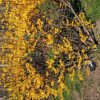
Forsythia suspensa (Vahl)
-
Forsythia togashii (Hara)
-
Forsythia viridissima (Lindl.)