
Genus Vicia in Subfamily Papilionoideae
In botanical taxonomy, a genus (plural genera) is a rank used to group closely related species within a family. In the hierarchy, genus sits below family and above species.
Genera are defined by shared morphological, anatomical, and genetic characteristics (for example, features of flowers, fruits, seeds, or leaves) that indicate a close evolutionary relationship among the species they contain.
Each genus can include one or more species. Examples include Rosa (roses) and Solanum (nightshades, including tomato and eggplant).
Do you wish to read more about plant taxonomy? Click here!
Genus Description
Suggest a correction!The genus Vicia L. (Leguminosae, subfamily Faboideae) comprises about 240 species, with Vicia sativa L. as the type species (POWO, 2024). It is widespread in temperate regions of the Northern Hemisphere, occurring from the Mediterranean basin through Europe and Asia to the Himalayas and North America, and many species are naturalized in disturbed habitats (WFO, 2024). Its members are primarily herbaceous climbers, ranging from low‑lying annuals to robust perennials.
Vicia consists of annual or perennial herbs, usually climbing by a terminal tendril. Leaves are paripinnate, stipules small and often non‑glandular. Flowers are papilionaceous, borne in axillary racemes or solitary; the single superior ovary bears marginal placentation. Fruit is a dehiscent pod containing one to several flattened seeds.
Species richness peaks in the Mediterranean and East Asia, where numerous endemics inhabit limestone soils and mountain slopes up to 3,500 m a.s.l. (Lewis & Lewis, 1995). Additional centres occur in the Caucasus and the Sino‑Himalayan corridor, reflecting long‑term isolation. The genus also includes several widespread weeds of agricultural fields and roadsides.
Pollination is primarily entomophilous by bees and butterflies, although many species are self‑compatible and set seed without pollinators. Seeds are explosively ejected from dehiscent pods, with occasional ant dispersal. Vicia species fix atmospheric nitrogen through rhizobial symbiosis and show a base chromosome number x = 7; diploids are typically 2n = 14, while polyploid series (2n = 28, 42) are frequent (Stewart et al., 2015).
Traditional classifications recognize sections such as Vicia sect. Vicia and Vicia sect. Faba, grouped into several subgenera (Lewis & Lewis, 1995). Molecular phylogenies place Vicia in tribe Fabeae, sister to Lathyrus, and support a broadly circumscribed Vicia (Doyle et al., 2020). However, proposals to split Faba into a separate genus illustrate ongoing taxonomic uncertainty; current treatments (POWO, 2024; WFO, 2024) retain the broad concept.
Vicia sativa and Vicia faba are cultivated for grain, forage and green‑manure, while Vicia villosa and related taxa serve as ornamental vines and cover crops. Some species, such as Vicia hirsuta, are considered agricultural weeds.
Conservation assessments remain incomplete, and many endemics are threatened by habitat loss. Continued field surveys and genomic delimitation will be essential to clarify species limits and prioritize conservation for the genus.
-
Vicia abbreviata (Fisch. ex Spreng.)
-
Vicia acutifolia (Elliott)
-
Vicia afghanica (Chrtková)
-
Vicia aintabensis (Boiss.)
-
Vicia aktoensis (Y.H.Wu)
-
Vicia alpestris (Steven)
2 -
Vicia alternans (Kit.)
-
Vicia altissima (Desf.)
-
Vicia americana (Muhl. ex Willd.)
2 -
Vicia amoena (Fisch.)
-
Vicia amurensis (Oett.)
-
Vicia anatolica (Turrill)
-
Vicia andicola (Kunth)
-
Vicia andina (Phil.)
-
Vicia anguste-pinnata (Nakai)
-
Vicia aphylla (C.Sm. ex Link)
-
Vicia araucana (Phil.)
-
Vicia argaea ((P.H.Davis) Greuter)
-
Vicia argentea (Lapeyr.)
-
Vicia armena (Boiss.)
-
Vicia articulata (Hornem.)
-
Vicia assyriaca (Boiss.)
-
Vicia aucheri (Boiss.)
-
Vicia bakeri (Ali)
-
Vicia balansae (Boiss.)
-
Vicia basaltica (Plitmann)
-
Vicia benghalensis (L.)
2 -
Vicia benthamiana (Ali)
-
Vicia berteroana (Phil.)
-
Vicia biebersteinii (M.Bieb.)
-
Vicia biennis (L.)
-
Vicia bifolia (Nakai)
-
Vicia bifoliolata (J.J.Rodr.)
-
Vicia bijuga (Gillies ex Hook. & Arn.)
-
Vicia bithynica (L.)
-
Vicia brulloi (Sciandr., Giusso, Salmeri & Miniss.)
-
Vicia bungei (Ohwi)
-
Vicia caesarea (Boiss. & Balansa)
-
Vicia canescens (Labill.)
2 -
Vicia cappadocica (Boiss.)
-
Vicia capreolata (Lowe)
-
Vicia caroliniana (Walter)
-
Vicia cassia (Boiss.)
-
Vicia cassubica (L.)
-
Vicia caucasica (Ekutim.)
-
Vicia cedretorum (Font Quer)
-
Vicia chaetocalyx (Webb & Berthel.)
-
Vicia chianschanensis ((P.Y.Fu & Y.A.Chen) Z.D.Xia)
-
Vicia chinensis (Franch.)
-
Vicia chosenensis (Ohwi)
-
Vicia ciceroidea (Boiss.)
-
Vicia ciliatula (Lipsky)
-
Vicia colladensis (Pérez Dacosta)
-
Vicia coquimbensis (Martic.)
-
Vicia costae (A.Hansen)
-
Vicia costata (Ledeb.)
-
Vicia cracca (L.)
-
Vicia cretica (Boiss. & Heldr.)
2 -
Vicia crocea ((Desf.) Fritsch)
-
Vicia cusnae (Foggi & Ricceri)
-
Vicia cuspidata (Boiss.)
-
Vicia cypria (Kotschy)
-
Vicia dadianorum (Sommier & Levier)
-
Vicia dalmatica (A.Kern.)
-
Vicia davisii (Greuter)
-
Vicia dennesiana (H.C.Watson)
-
Vicia dichroantha (Diels)
-
Vicia dionysiensis (Mouterde)
-
Vicia disperma (DC.)
-
Vicia dumetorum (L.)
-
Vicia epetiolaris (Burkart)
2 -
Vicia eriocarpa ((Hausskn.) Halácsy)
-
Vicia eristalioides (Maxted)
-
Vicia ervilia ((L.) Willd.)
-
Vicia erzurumica (N.Demirkuș & S.Erik)
-
Vicia esdraclonensis (Warb. & Eig)
-
Vicia esdraelonensis (Warb. & Eig)
-
Vicia faba (L.)
-
Vicia fairchildiana (Maire)
-
Vicia fauriei (Franch.)
-
Vicia fedtschenkoana (V.A.Nikitin)
-
Vicia ferreirensis (Goyder)
-
Vicia filicaulis (Webb & Berthel.)
-
Vicia floridana (S.Watson)
-
Vicia freyniana (Bornm.)
-
Vicia fulgens (Batt.)
-
Vicia galeata (Boiss.)
-
Vicia galilaea (Plitmann & Zohary)
-
Vicia garinensis (Dehshiri)
-
Vicia geminiflora (Trautv.)
-
Vicia giacominiana (Segelb.)
-
Vicia glareosa (P.H.Davis)
-
Vicia glauca (C.Presl)
-
Vicia gracilior ((Popov) Popov)
-
Vicia graminea (Sm.)
3 -
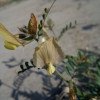
Vicia grandiflora (Scop.)
-
Vicia guyotii (Beauverd)
-
Vicia hassei (S.Watson)
-
Vicia hatschbachii (Burkart ex Vanni & D.B.Kurtz)
-
Vicia hirsuta ((L.) Gray)
-
Vicia hololasia (Woronow)
-
Vicia hulensis (Plitmann)
-
Vicia humilis (Kunth)
-
Vicia hyaeniscyamus (Mouterde)
-
Vicia hybrida (L.)
-
Vicia hyrcanica (Fisch. & C.A.Mey.)
-
Vicia iberica (Grossh.)
-
Vicia incana (Gouan)
-
Vicia inconspicua (Phil.)
-
Vicia iranica (Boiss.)
-
Vicia jadhavii (R.Kr.Singh & Arigela)
-
Vicia janeae (Mardal.)
-
Vicia japonica (A.Gray)
-
Vicia johannis (Tamamsch.)
-
Vicia jordanovii (Velchev)
-
Vicia kalakhensis (Khattab, Maxted & F.A.Bisby)
-
Vicia khokhriakovii (Vorosch.)
-
Vicia kioshanica (L.H.Bailey)
-
Vicia koeieana (Rech.f.)
-
Vicia kokanica (Regel & Schmalh.)
-
Vicia kotschyana (Boiss.)
-
Vicia kulingana (L.H.Bailey)
-
Vicia kurdica (Jalilian)
-
Vicia laeta (Ces.)
-
Vicia lanceolata (Phil.)
-
Vicia larissae (Prima)
-
Vicia lathyroides (L.)
-
Vicia latibracteolata (K.T.Fu)
-
Vicia lecomtei (Humbert & Maire)
-
Vicia lens ((L.) Coss. & Germ.)
3 -
Vicia lenticula ((Hoppe) Janka)
-
Vicia lentoides ((Ten.) Coss. & Germ.)
-
Vicia leucantha (Biv.)
-
Vicia leucomalla (Bornm.)
-
Vicia leucophaea (Greene)
-
Vicia lilacina (Ledeb.)
-
Vicia linearifolia (Hook. & Arn.)
-
Vicia loiseleurii ((M.Bieb.) H.Lindb.)
-
Vicia lomensis (J.F.Macbr.)
-
Vicia longicuspis (Z.D.Xia)
-
Vicia longifolia (Poir.)
-
Vicia ludoviciana (Nutt.)
4 -
Vicia lunata ((Boiss. & Balansa) Boiss.)
2 -
Vicia lutea (L.)
3 -
Vicia macrantha (Jurtzev)
-
Vicia macrograminea (Burkart)
-
Vicia magellanica (Hook.f.)
2 -
Vicia megalotropis (Ledeb.)
-
Vicia melanops (Sm.)
-
Vicia menziesii (Spreng.)
-
Vicia michauxii (Spreng.)
-
Vicia micrantha (Lowe)
-
Vicia mingyueshanensis (Z.Y.Xiao & X.C.Li)
-
Vicia minutiflora (D.Dietr.)
-
Vicia modesta (Phil.)
-
Vicia mollis (Boiss.)
-
Vicia monantha (Retz.)
2 -
Vicia monardi (Boiss. & Reut.)
-
Vicia montbretii (Fisch. & C.A.Mey.)
-
Vicia montenegrina (Rohlena)
-
Vicia montevidensis (Vogel)
-
Vicia mucronata (Clos)
-
Vicia mulleriana (B.L.Turner)
-
Vicia multicaulis (Ledeb.)
-
Vicia multijuga ((Boiss.) Rech.f.)
-
Vicia murbeckii (Maire)
-
Vicia nana (Vogel)
-
Vicia narbonensis (L.)
-
Vicia nataliae (U.Reifenb. & A.Reifenb.)
-
Vicia nigricans (Hook. & Arn.)
2 -
Vicia nipponia (Matsum.)
-
Vicia nipponica (Matsum.)
-
Vicia noeana (Boiss. & Reut.)
-
Vicia nummularia (Hand.-Mazz.)
-
Vicia ocalensis (R.K.Godfrey & Kral)
-
Vicia ochroleuca (Ten.)
4 -
Vicia ohwiana (Hosok.)
-
Vicia olchonensis ((Peschkova) O.D.Nikif.)
-
Vicia onobrychioides (L.)
-
Vicia orientalis ((Boiss.) Bég. & Diratz.)
-
Vicia oroboides (Wulfen)
-
Vicia orobus (DC.)
-
Vicia palaestina (Boiss.)
-
Vicia pallens (Rchb.)
-
Vicia pallida (Hook. & Arn.)
-
Vicia pampicola (Burkart)
2 -
Vicia pannonica (Crantz)
-
Vicia parviflora (Cav.)
-
Vicia parvula (Ziel.)
-
Vicia paucifolia (Baker)
2 -
Vicia pectinata (Lowe)
-
Vicia peregrina (L.)
2 -
Vicia perelegans (K.T.Fu)
-
Vicia peruviana (Vigo)
-
Vicia pinetorum (Boiss. & Spruner)
-
Vicia pisiformis (L.)
-
Vicia platensis (Speg.)
-
Vicia popovii (O.D.Nikif.)
-
Vicia pseudo-orobus (Fisch. & C.A.Mey.)
-
Vicia pseudocassubica (Rech.f.)
-
Vicia pubescens ((DC.) Link)
-
Vicia pulchella (Kunth)
-
Vicia pyrenaica (Pourr.)
-
Vicia qatmensis (Gomb.)
-
Vicia quadrijuga (P.H.Davis)
-
Vicia ramosissima (Franch.)
-
Vicia ramuliflora ((Maxim.) Ohwi)
-
Vicia raynaudii (Coulot & Dobignard)
-
Vicia rigidula (Royle)
-
Vicia sabinarum (J.Gil)
-
Vicia sativa (L.)
9 -
Vicia scandens (R.P.Murray)
-
Vicia semenovii ((Regel & Herder) B.Fedtsch.)
-
Vicia semenowi ((Regel & Herder) B.Fedtsch.)
-
Vicia semiglabra (Rupr. ex Boiss.)
-
Vicia sepium (L.)
-
Vicia sericocarpa (Fenzl)
-
Vicia serratifolia (Jacq.)
-
Vicia sessei (G.Don)
-
Vicia sessiliflora (Clos)
-
Vicia setidens (Bornm.)
-
Vicia setifolia (Kunth)
2 -
Vicia sibthorpii (Boiss.)
-
Vicia sicula ((Raf.) Guss.)
-
Vicia sinaica (Boulos)
-
Vicia singarensis (Boiss. & Hausskn.)
-
Vicia sosnowskyi (Ekutim.)
-
Vicia sparsiflora (Ten.)
-
Vicia splendens (P.H.Davis)
-
Vicia stenophylla (Vogel)
-
Vicia subrotunda ((Maxim.) Czefr.)
-
Vicia subserrata (Phil.)
-
Vicia subvillosa ((Ledeb.) Boiss.)
-
Vicia sylvatica (L.)
-
Vicia taipaica (K.T.Fu)
-
Vicia tenera (Benth.)
-
Vicia tenoi (Marrero Rodr.)
-
Vicia tenuifolia (Roth)
6 -
Vicia tenuissima ((M.Bieb.) Schinz & Thell.)
-
Vicia tephrosioides (Vogel)
-
Vicia ternata (Z.D.Xia)
-
Vicia tetrantha (H.W.Kung)
-
Vicia tetrasperma ((L.) Moench)
-
Vicia tibetica (Prain ex C.E.C.Fisch.)
-
Vicia tigridis (Mouterde)
-
Vicia tikeliana (Starm.)
-
Vicia tsydenii (Malyschev)
-
Vicia unijuga (A.Br.)
-
Vicia uralensis (Knjaz., Kulikov & E.G.Philippov)
-
Vicia variegata (Willd.)
3 -
Vicia venosa ((Willd. ex Link) Maxim.)
6 -
Vicia venulosa (Boiss. & Hohen.)
-
Vicia vicina (Clos)
-
Vicia vicioides ((Desf.) Cout.)
-
Vicia villosa (Roth)
6 -
Vicia voggenreiteriana (J.Gil, R.Mesa & M.L.Gil)
-
Vicia vulcanorum (J.Gil & M.L.Gil)
-
Vicia woroschilovii (N.S.Pavlova)
-
Vicia wushanica (Z.D.Xia)
-
Vicia zabelii (Asch. & Graebn.)