
Colocasia esculenta
Table of Contents
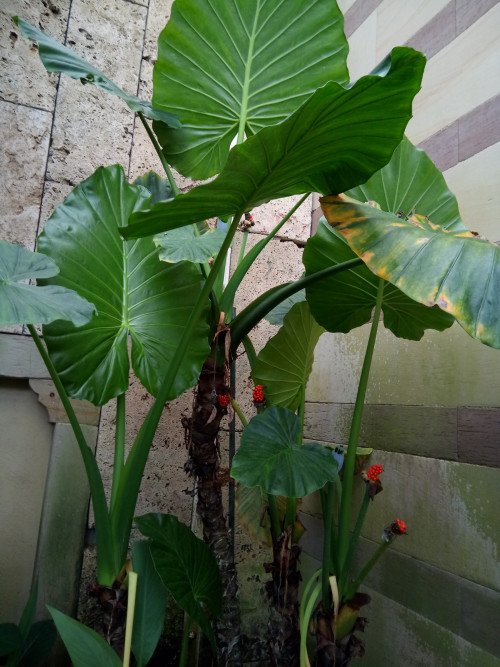
Details Top
| Internal ID | UUID644034738e83d225723498 |
| Scientific name | Colocasia esculenta |
| Authority | (L.) Schott |
| First published in | Melet. Bot. : 18 (1832) |
Ethnobotanical Use Top
Suggest a correction!
Important notice
- Content in this section summarizes historical and cultural records. It is not medical advice.
- Do not use plants for self-treatment. Safety, efficacy, and appropriate use are not established here.
- Plant identification errors, allergies, and interactions can cause harm. Consult qualified professionals for health questions.
- Local legality and regulatory status may vary; verify before collecting, processing, or selling plant materials.
Colocasia esculenta (taro) is among the world’s most widely cultivated aroids, and in several parts of South Asia, West Africa, and the Pacific its leaves are taken as medicinal infusions or decoctions. In southern India the aerial parts are prepared as a mild decoction to reduce fever and as an expectorant for coughs, while in Nepal the leaf decoction is drunk for intestinal upset, particularly in cases of diarrhea. Among the Bantu-speaking peoples of northern Nigeria, communities boil mature leaves in water and drink the decoction for fevers and bronchial complaints, and in parts of coastal eastern Nigeria the same preparation is used as an emollient wash for painful, inflamed joints. In Samoa and neighboring Polynesian islands, cooked leaf juice is given as a diaphoretic infusion to break fevers and to soothe coughs, and similar leaf infusions are recorded in coastal Vanuatu for colds and convalescent convalescence. These uses are reported in regional ethnobotanical surveys of India and the Pacific, and in ethnomedical accounts from Nigeria (Dongo et al., 2010; Kargbo et al., 2020; Western Ghats field notes reported by Singh et al., 2012; Venus et al., Pacific ethnobotany; Western Polynesian community reports, 2015).
A simple leaf decoction can be prepared by bringing 500 ml of water to a boil with 1 tablespoon (approximately 3 g) of clean, mature taro leaf strips, reducing to a gentle simmer for 5–8 minutes, then straining and cooling before use. A small cup (about 50–100 ml) can be taken two or three times a day for fever or cough. Because taro leaves contain calcium oxalate raphides that can irritate mucosa and skin, only tender young leaves should be used, and the liquid must be filtered before drinking. Limit use to a few days unless advised by a clinician; avoid in pregnancy and in individuals with known hypersensitivity or oxalate-sensitive conditions, and do not consume any preparation made from the raw leaf due to sap irritation and potential oxalate exposure.
Flavonoids such as quercetin and kaempferol glycosides are well documented in taro leaves, along with phenolic acids and triterpenoids including lupeol and β‑sitosterol; these groups align with the reported antipyretic, expectorant, antidiarrheal, and anti‑inflammatory activities of the infusions. Polysaccharide starches and mucilaginous polysaccharides in the corm additionally contribute soothing, demulcent effects in related preparations reported from South Asia.
Today, fresh taro leaves are still sold seasonally in many Asian and African markets, and in parts of the Pacific the leaf infusion remains a household remedy for fever and respiratory discomfort. Research continues on the chemistry and pharmacology of C. esculenta, and its leaf teas and decoctions remain part of living practice where the plant is traditionally cultivated.
General Uses Top
Suggest a correction!Food and beverages (non-medicinal):
Cormels and corms are peeled, boiled, steamed, fried, or roasted and used whole, sliced, or mashed as staple starchy vegetables in tropical and subtropical cuisines. Corm paste and flour are used to make breads, porridges, puddings, and dumplings; flour also replaces part of wheat flour in gluten-free formulations. Edible corm starch is extracted industrially for use in foods as a thickener, gelling agent, and in extruded products. Young leaves and stems are consumed as leafy vegetables after thorough cooking to reduce calcium oxalate raphides.
Industrial and craft applications:
Extracts and derivatives of corms, leaves, and aerial parts are used in research to develop biodegradable films, hydrogels, and composite materials; these are documented in academic literature but are not yet widely commercialized. Some studies report use of taro flour in plywood and paper adhesives and as a fermentation feedstock for bioethanol, though large-scale industrial adoption is not documented.
Scientific/model-organism use:
Colocasia esculenta is a reference species for aroid genetics and breeding programs. Whole-genome sequencing and assembly resources, together with genomic databases and community collections, support functional genomics, transcriptomics, marker-assisted selection, and comparative studies within Araceae.
Properties relevant to use:
Corm starch is characterized by high amylose content, an intermediate granule size, and cold-set paste behavior; cooked pastes exhibit high viscosity and gel stability. Cooking reduces calcium oxalate raphides in leaves and stems, enabling safe consumption.
Standards and regulation:
Food uses comply with national food standards and labeling norms, which require species identity and processing details such as product form (fresh produce, flour, starch), as applicable. For industrial materials based on taro extracts in food-contact or specialty applications, relevant ISO/ASTM/EN standards for material safety and performance apply by application, but specific standards explicitly tailored to taro-based extracts are not established.
Sustainability and sourcing:
Corm and leaf production is concentrated in tropical regions and relies on supplemental irrigation and nutrient inputs; water use and field requirements vary with cultivar and climate. Post-harvest losses can be significant; processing into flour or starch stabilizes supply and reduces losses, while utilization of leaves and stems improves resource efficiency.
Synonyms Top
| Scientific name | Authority | First published in |
|---|---|---|
| Leucocasia esculenta | Nakai | Bull. Natl. Sci. Mus. Tokyo 31: 127 (1952) |
| Aron colocasium | St.-Lag. | Ann. Soc. Bot. Lyon 7: 119 (1880) |
| Arum chinense | L. | Amoen. Acad. 4: 234. 1754 (1754) |
| Arum colocasia | L. | Sp. Pl. : 965 (1753) |
| Arum colocasioides | Desf. | Tabl. École Bot. , ed. 3: 7 (1829) |
| Arum esculentum | L. | Sp. Pl. : 965 (1753) |
| Arum lividum | Salisb. | Prodr. Stirp. Chap. Allerton : 260 (1796) |
| Arum nymphaeifolium | Roxb. | Hort. Bengal. : 65 (1814) |
| Arum peltatum | Lam. | Encycl. 3: 13 (1789) |
| Zantedeschia virosa | K.Koch | Index Seminum (B, Berolinensis) 1854(App.): 9 (1855) |
| Colocasia antiquorum f. acuatica | Makino | J. Jap. Bot. 3: 15 1926 |
| Colocasia antiquorum f. eguimo | Makino | J. Jap. Bot. 3: 15 1926 |
| Colocasia antiquorum f. oyasetage | Makino | J. Jap. Bot. 3: 15 1926 |
| Colocasia antiquorum f. purpurea | Makino | J. Jap. Bot. 3: 15 1926 |
| Colocasia antiquorum f. yamamotoi | Makino | J. Jap. Bot. 3: 15 1926 |
| Colocasia antiquorum var. multifolia | Makino | J. Jap. Bot. 1: 4. 1916 |
| Caladium acre | R.Br. | Prodr. Fl. Nov. Holland. : 336 (1810) |
| Caladium colocasia | W.Wight | Contr. U.S. Natl. Herb. ix. 206. 1905 [8 Apr 1905] |
| Caladium colocasioides | Brongn. | Nouv. Ann. Mus. Hist. Nat. 3: 156 (1834) |
| Caladium esculentum | Vent. | Descr. Pl. Nouv. : t. 30 (1801) |
| Caladium glycyrrhizum | C.Fraser | Bot. Misc. 1: 259 (1830) |
| Caladium nymphaeifolium | Vent. | Descr. Pl. Nouv. : t. 30 (1801) |
| Caladium violaceum | Desf. | Tabl. École Bot. , ed. 3: 7 (1829) |
| Caladium violaceum | hort. ex Engl. | Monogr. Phan. 2: 492 (1879) |
| Calla gaby | Blanco | Fl. Filip. : 659 (1837) |
| Calla virosa | Roxb. | Fl. Ind. ed. 1832 , 3: 517 (1832) |
| Colocasia antiquorum var. patens | Makino | Somoku-Dzusetsu ed. 3, 4: 1253. 1912 |
| Colocasia antiquorum var. rosea | Makino | Somoku-Dzusetsu ed. 3, 4: 1253. 1912 |
| Colocasia esculenta f. ebiimo | Makino | Pract. Hort. 16(10): 996 1940 |
| Colocasia esculenta f. rotundifolia | Makino | Pract. Hort. 16(10): 996 1940 |
| Colocasia antiquorum var. acris | (R.Br.) Schott | Syn. Aroid. 41. 1856 |
| Colocasia antiquorum var. esculenta | (L.) Schott | Syn. Aroid. 41. 1856 |
| Colocasia antiquorum var. euchlora | (K.Koch & Linden) Schott | Syn. Aroid. 42. 1856 |
| Colocasia antiquorum var. fontanesii | (Schott) Schott | Syn. Aroid. 42. 1856 |
| Colocasia antiquorum var. illustris | (W.Bull) Engl. | Monogr. Phan. 2: 492. 1879 |
| Colocasia antiquorum var. nymphaeifolia | (Vent.) Engl. | Monogr. Phan. 2: 492. 1879 |
| Colocasia esculenta var. acris | (R.Br.) A.F.Hill | Bot. Mus. Leafl. 7: 117. 1939 |
| Colocasia esculenta var. euchlora | (K.Koch & Linden) A.F.Hill | Bot. Mus. Leafl. 7: 117. 1939 |
| Colocasia esculenta var. fontanesii | (Schott) A.F.Hill | Bot. Mus. Leafl. 7: 118. 1939 |
| Colocasia esculenta var. globulifera | (Engl. & K.Krause) R.A.Young | Bull. U.S.D.A. (1895-1901) 1924: 1247 1924 |
| Colocasia esculenta var. illustris | (W.Bull) A.F.Hill | Bot. Mus. Leafl. 7: 118. 1939 |
| Colocasia esculenta var. nymphaeifolia | (Kunth) A.F.Hill | Bot. Mus. Leafl. 7: 116 1939 |
| Colocasia antiquorum var. globulifera | Engl. & K.Krause | Pflanzenr. IV, 23E: 68. 1920 |
| Colocasia acris | (R.Br.) Schott | Meletemata Botanica 1832 |
| Colocasia aegyptiaca | (Hill) Samp. | Herb. Port. , Apend 2: 3 (1914) |
| Colocasia antiquorum var. rupicola | Haines | Bot. Bihar Orissa 5: 867 1924 |
| Colocasia antiquorum var. stolonifera | Haines | Bot. Bihar Orissa 5: 867 1924 |
| Colocasia colocasia | Huth | Helios 11: 134 (1893) |
| Colocasia esculenta var. antiquorum | (Schott) F.T.Hubb. & Rehder | Bot. Mus. Leafl. 1(1): 5. 1932 |
| Colocasia esculenta var. aquatilis | Hassk. | Pl. Jav. Rar. 150. 1840 |
| Colocasia esculenta var. rupicola | (Haines) H.B.Naithani | Fl. Pl. India : 454 (1990) |
| Colocasia esculenta var. stolonifera | (Haines) H.B.Naithani | Fl. Pl. India : 454 (1990) |
| Colocasia euchlora | K.Koch & Linden | Index Seminum (B, Berolinensis) 1854(App.): 4 (1855) |
| Colocasia formosana | Hayata | Icon. Pl. Formosan. 8: 133 (1919) |
| Colocasia gracilis | Engl. | Bot. Jahrb. Syst. 1: 185 (1880) |
| Colocasia himalensis | Royle | Ill. Bot. Himal. Mts. : 407 (1840) |
| Colocasia konishii | Hayata | Icon. Pl. Formosan. 8: 134 (1919) |
| Colocasia neocaledonica | v.Houtte | Nursery Cat. (Louis van Houtte) 1885: ? (1885) |
| Colocasia nymphaeifolia | Kunth | Enum. Pl. 3: 37 (1841) |
| Colocasia peltata | Samp. | Herb. Port. : 12 (1913) |
| Colocasia tonoimo | Nakai | Iconogr. Pl. Asiae Orient. 3: 231 (1940) |
| Colocasia vera | Hassk. | Flora 25(2 Beibl. 1): 81. 1842 (1842) |
| Colocasia virosa | Kunth | Enum. Pl. 3: 41 (1841) |
| Colocasia vulgaris | Raf. | Fl. Tellur. 3: 65 (1837) |
| Alocasia dussii | Dammer | Gartenflora 1892: 312 (1892) |
| Alocasia illustris | W.Bull | Gard. Chron. 1873: 606 (1873) |
| Colocasia antiquorum var. aquatilis | (Hassk.) Engl. & K.Krause | Pflanzenr. IV 23E(Heft 71): 68 1920 |
| Colocasia antiquorum | Schott | Melet. Bot. : 18 (1832) |
| Colocasia violacea | (Desf.) Anon. | Bot. Mag. 126: t. 7732 (1900) |
| Caladium nigrescens | André | Pl. Feuill. Ornem. 113 (1866) |
| Caladium atrovirens | André | Pl. Feuill. Ornem. 113 (1866) |
| Caladium divaricatum | André | Pl. Feuill. Ornem. 113 (1866) |
| Caladium parimaense | André | Pl. Feuill. Ornem. 113 (1866) |
| Caladium violaceum var. alboviolaceum | André | Pl. Feuill. Ornem. : 112 (1866) |
| Colocasia antiquorum var. typica | Engl. | Monogr. Phan. 2: 491 (1879) |
| Colocasia esculenta var. typica | A.F.Hill | Bot. Mus. Leafl. 7: 116 (1939) |
| Caladium esculentum unranked bataviensis | Hovey | Nursery Cat. (Hovey & co.) 1882: 22 (1882) |
| Caladium antiquorum | (Schott) André | Pl. Feuill. Ornem. 113 (1866) |
Common names Top
Add a new one! Suggest a correction!| Language | Common/alternative name |
|---|---|
| English | coco yam |
| English | wild taro |
| English | taro |
| English | dasheen |
| English | godere |
| English | kalo |
| English | olhuala |
| English | eddoe |
| Spanish | madumbe |
| Spanish | calla gaby |
| ace | eumpeuek |
| Afrikaans | taro |
| Akan | brobe |
| Amharic | ጎደሬ |
| Arabic | قلقاس |
| Arabic | آذان الفيل |
| Arabic | أبو درقة |
| Arabic | قلقاس مأكول |
| ban | keladi |
| bcl | natong |
| bdr | gulai kadi |
| Bulgarian | колоказия |
| Bulgarian | трилистник |
| Bulgarian | таро |
| bho | अरुई |
| bi | taro |
| bjn | kaladi |
| Bengali | জংলিকচু |
| Bengali | বুনোকচু |
| Bengali | কচু |
| Catalan | taro |
| Catalan | eddoe |
| ceb | laing |
| ceb | natong |
| Czech | taro |
| Czech | kolokázie jedlá |
| dag | bankani |
| German | kolokasie |
| German | wasserbrotwurzel |
| German | taro |
| dtp | guol |
| dv | އޮޅު އަލަ |
| Greek | Κολοκασία η εδώδιμος |
| Esperanto | manĝebla kolokazio |
| Esperanto | taro |
| Basque | taro |
| Persian | اسکولنتا |
| Finnish | dasheen |
| Finnish | eddo |
| Finnish | taro |
| Finnish | taaro |
| Finnish | colocasia antiquorum |
| fj | dalo |
| French | colocase |
| French | eddo |
| French | eddoe |
| French | taro de montagne |
| French | taro sauvage |
| French | yamaimo |
| French | yeyu |
| French | taro |
| frr | taro |
| Galician | taro |
| Gujarati | અળવી |
| Hausa | gwaza |
| Hawaiian | kalo |
| Hebrew | קולקס |
| Hindi | अरबी सब्जी |
| Croatian | taro |
| ht | chou karayib |
| Hungarian | taró |
| Indonesian | talas |
| Igbo | ede |
| ilo | aba |
| Italian | taro |
| Japanese | サトイモ |
| Japanese | さといも |
| Japanese | 唯芋 |
| Japanese | 洗芋 |
| Japanese | 芋の子 |
| Japanese | 蓑芋 |
| Japanese | 里芋 |
| Japanese | 鶴の子芋 |
| Japanese | ヤマサトイモ |
| jv | mbothe |
| jv | tales |
| Georgian | ტარო |
| kge | talos |
| Kazakh | Таро |
| Kannada | ಕೆಸು |
| Korean | 토란 |
| la | taro |
| lfn | taro |
| Lithuanian | taro |
| Lithuanian | valgomoji kolokazija |
| Lithuanian | arum esculentum |
| Lithuanian | caladium esculentum |
| Lithuanian | colocasia antiquorum |
| Latvian | kolokāzija |
| Latvian | taro |
| Latvian | ēdamā kolokāzija |
| lzh | 芋 |
| mad | tales |
| Malagasy | saonjo |
| mi | taro |
| min | kaladi |
| Macedonian | таро |
| Malayalam | താള് |
| mnc | ᡥᡡᡧᠠᠵᡠ |
| mni | ꯌꯦꯟꯗꯦꯝ |
| Marathi | अळू |
| Malay | keladi cina |
| nan | Ō·-á |
| nan | Ō͘-á |
| Norwegian Bokmål | taro |
| Nepali | कच्छु |
| nia | talö |
| Dutch | eddoe |
| Dutch | taro |
| Norwegian Nynorsk | taro |
| Punjabi | ਅਰਵੀ |
| pam | gandus |
| Polish | taro |
| Polish | kolokazja jadalna |
| Punjab | اروی |
| Portuguese | inhame dos açores |
| Portuguese | taro |
| pwn | vasa |
| rn | amateke |
| Russian | Дашин |
| Russian | Колоказия древняя |
| Russian | Колоказия съедобная |
| Russian | Эддо |
| Russian | Таро |
| sat | ᱥᱟ.ᱨᱩ |
| sco | taro |
| Sango | langä |
| Slovenian | taro |
| sm | talo |
| Serbian | Таро |
| su | kimpul |
| Swedish | taro |
| Swahili | magimbi |
| szy | tali |
| Tamil | சேம்பு |
| tay | sayhuy |
| tay | cehuy |
| tcy | ಚೇವು |
| Thai | เผือก |
| Thai | บอนห้วย |
| Tonga | xanthosoma sagittifolium |
| Tonga | talo |
| Tonga | colocasia antiquorum |
| Turkish | gölevez |
| trv | sari |
| ty | taro |
| Ukrainian | годере |
| Ukrainian | дашин |
| Ukrainian | еддо |
| Ukrainian | кало |
| Ukrainian | кокоямс |
| Ukrainian | колоказія древня |
| Ukrainian | колоказія їстівна |
| Ukrainian | Таро |
| Urdu | تارو |
| Urdu | اروی |
| Vietnamese | môn nước |
| Vietnamese | khoai nước |
| Vietnamese | khoai môn |
| Vietnamese | khoai sọ |
| xmf | ტარო (ჩანარი) |
| za | biek |
| Chinese | 水芋 |
| Chinese | 台芋 |
| Chinese | 毛芋头 |
| Chinese | 接骨草 |
| Chinese | 莒 |
| Chinese | 红芋 |
| Chinese | 紫芋 |
| Chinese | 芋 |
| Chinese | 香芋 |
| Chinese | 九头芋 |
| Chinese | 古夫芋 |
| Chinese | 台灣青芋 |
| Chinese | 吉安毛子芋 |
| Chinese | 大紫芋 |
| Chinese | 姜巴芋 |
| Chinese | 开花芋 |
| Chinese | 日本叶用芋 |
| Chinese | 沙市糯芋 |
| Chinese | 溧阳红芽芋 |
| Chinese | 滇南芋 |
| Chinese | 燕窝 |
| Chinese | 狗头芋 |
| Chinese | 甜芋 |
| Chinese | 绿芋 |
| Chinese | 芋(茵芋) |
| Chinese | 芋叶 |
| Chinese | 芋头 |
| Chinese | 芋头花 |
| Chinese | 芋梗 |
| Chinese | 蹲鸱 |
| Chinese | 野芋 |
| Chinese | 长臂芋 |
| Chinese | 麻芋头 |
| Chinese | 黑耿鸭蛋芋 |
| Chinese | 黑芋 |
| Chinese | 土芝 |
| Chinese | 毛艿 |
| Chinese | 毛芋 |
| Chinese | 独皮叶 |
| Chinese | 芋岌 |
| Chinese | 青皮叶 |
| Chinese | 芋仔 |
| Chinese | 芋艿 |
| Chinese | 芋頭 |
| Chinese | 荔芋 |
| Chinese | 里芋 |
| Chinese | 山野芋 |
| Chinese | 野芋头 |
| Chinese | 野山芋 |
| Chinese | 野芋叶 |
| Chinese | 红广菜 |
| Zulu | amadumbe |
Germination/Propagation Top
Suggest a correction or add new data!
No germination or propagation data was added yet.
Distribution (via POWO/KEW) Top
Legend for the distribution data:
- Doubtful data
- Extinct
- Introduced
- Native
-
Africa click to expand
-
Macaronesia
- Azores
- Canary Islands
- Madeira
-
Middle Atlantic Ocean
- Saint Helena
-
Northeast Tropical Africa
- Chad
- Socotra
- Sudan
-
Northern Africa
- Algeria
- Morocco
- Tunisia
-
South Tropical Africa
- Malawi
- Zambia
- Zimbabwe
-
West Tropical Africa
- Benin
- Gambia
- Guinea-Bissau
- Ivory Coast
- Senegal
- Togo
-
West-central Tropical Africa
- Cameroon
- Central African Republic
- Congo
- Gulf Of Guinea Islands
- Zaïre
-
Western Indian Ocean
- Chagos Archipelago
- Comoros
- Madagascar
- Seychelles
-
Macaronesia
-
Asia-temperate click to expand
-
China
- China South-central
- China Southeast
-
Eastern Asia
- Japan
- Korea
- Taiwan
-
Western Asia
- East Aegean Islands
- Turkey
-
China
-
Asia-tropical click to expand
-
Indian Subcontinent
- Assam
- Bangladesh
- East Himalaya
- India
- Laccadive Islands
- Maldives
- Nepal
- Sri Lanka
- West Himalaya
-
Indo-China
- Andaman Islands
- Cambodia
- Laos
- Myanmar
- Nicobar Nicobar
- Thailand
- Vietnam
-
Malesia
- Christmas Island
- Jawa
- Lesser Sunda Islands
- Malaya
- Sulawesi
- Sumatera
-
Papuasia
- Bismarck Archipelago
- New Guinea
- Solomon Islands
-
Indian Subcontinent
-
Australasia click to expand
-
Australia
- New South Wales
- Norfolk Island
- Queensland
- Western Australia
-
New Zealand
- Kermadec Islands
-
Australia
-
Europe click to expand
-
Southeastern Europe
- Italy
- Sicilia
- Yugoslavia
-
Southwestern Europe
- Baleares
- Portugal
- Sardegna
- Spain
-
Southeastern Europe
-
Northern America click to expand
-
Mexico
- Mexico Southwest
-
South-central U.S.A.
- Texas
-
Southeastern U.S.A.
- Alabama
- Florida
- Louisiana
- Mississippi
-
Mexico
-
Pacific click to expand
-
North-central Pacific
- Hawaii
-
Northwestern Pacific
- Caroline Islands
-
South-central Pacific
- Cook Islands
- Easter Island
- Line Islands
- Marquesas
- Society Islands
- Tuamotu
-
Southwestern Pacific
- Gilbert Islands
- Nauru
- New Caledonia
- Niue
- Samoa
- Santa Cruz Island
- Tonga
- Tuvalu
- Vanuatu
- Wallis-Futuna Islands
-
North-central Pacific
-
Southern America click to expand
-
Brazil
- Brazil North
- Brazil Northeast
- Brazil South
-
Caribbean
- Bermuda
- Cayman Islands
- Cuba
- Dominican Republic
- Haiti
- Leeward Islands
- Puerto Rico
- Trinidad-Tobago
- Venezuelan Antilles
- Windward Islands
-
Central America
- Costa Rica
- Honduras
- Nicaragua
-
Northern South America
- Guyana
- Venezuela
-
Southern South America
- Paraguay
-
Western South America
- Bolivia
- Colombia
- Ecuador
- Galápagos
- Peru
-
Brazil
Links to other databases Top
Suggest others/fix!| Database | ID/link to page |
|---|---|
| World Flora Online | wfo-0000917419 |
| UNII | 17GW8Z867C |
| Florida Plant Atlas | 209 |
| Flora of Alabama | 3810 |
| USDA Plants | COES |
| Tropicos | 2102373 |
| INPN | 447722 |
| Flora of Italy | 7848 |
| KEW | urn:lsid:ipni.org:names:1170772-2 |
| The Plant List | kew-46275 |
| Missouri Botanical Garden | 276338 |
| Open Tree Of Life | 1008203 |
| Observations.org | 124627 |
| NCBI Taxonomy | 4460 |
| NBN Atlas | NBNSYS0200003603 |
| Nature Serve | 2.144891 |
| IUCN Red List | 169058 |
| IPNI | 1170772-2 |
| iNaturalist | 122835 |
| GBIF | 5330776 |
| Freebase | /m/0410vr2 |
| EPPO | CXSES |
| EOL | 1091931 |
| Elurikkus | 3884 |
| Calflora (Californian flora) | 13042 |
| US Library of Congress | sh85132678 |
| USDA GRIN | 11177 |
| Wikipedia | Taro |
| Tropicos | 2102369 |
| KEW | urn:lsid:ipni.org:names:86580-1 |
| The Plant List | kew-46266 |
| Open Tree Of Life | 905242 |
| NCBI Taxonomy | 199218 |
| NBN Atlas | NBNSYS0000014244 |
| IPNI | 86069-3 |
| iNaturalist | 202344 |
| GBIF | 5330777 |
| Freebase | /m/09gp6vm |
| EPPO | CXSAN |
| EOL | 1091934 |
| USDA GRIN | 11175 |
| Wikipedia | Eddoe |
| PFAF | Colocasia esculenta |
Genomes (via NCBI) Top
Below is displayed the reference genome only!
If you wish to browse all genomes for this plant click here.
If you wish to browse all genomes for this plant click here.
| Accession | Assembly | |||||
|---|---|---|---|---|---|---|
| Name | Level | Submitter | Released | Coverage | Size | |
| GCA_053894955.1 | ASM5389495v1 | Chromosome | Wuhan academy of agricultural sciences | 2025-12-10 | 34.6 | 2.18 Gb |
Scientific Literature Top
Below are displayed the latest 15 articles published in PMC (PubMed Central®) and other sources (DOI number only)!
If you wish to see all the related articles click here.
If you wish to see all the related articles click here.
| Title | Authors | Publication | Released | IDs | ||||||
|---|---|---|---|---|---|---|---|---|---|---|
| On-farm crop diversity, conservation, importance and value: a case study of landraces from Western Ghats of Karnataka, India | Puneeth GM, Gowthami R, Katral A, Laxmisha KM, Vasudeva R, Singh GP, Archak S | Sci Rep | 10-May-2024 |
|
||||||
| Risk assessment of Retithrips syriacus for the EU | Bragard C, Baptista P, Chatzivassiliou E, Di Serio F, Gonthier P, Jaques Miret JA, Justesen AF, MacLeod A, Magnusson CS, Milonas P, Navas‐Cortes JA, Parnell S, Potting R, Reignault PL, Stefani E, Thulke H, van der Werf W, Yuen J, Zappalà L, Bezerra Lima ÉF, Makowski D, Crotta M, Gobbi A, Golic D, Maiorano A, Mosbach‐Schulz O, Rossi E, Terzidou A, Vicent Civera A | EFSA J | 29-Apr-2024 |
|
||||||
| Vegetation dieback in the Mississippi River Delta triggered by acute drought and chronic relative sea-level rise | Elsey-Quirk T, Lynn A, Jacobs MD, Diaz R, Cronin JT, Wang L, Huang H, Justic D | Nat Commun | 25-Apr-2024 |
|
||||||
| Viral Threats to Fruit and Vegetable Crops in the Caribbean | Tennant P, Rampersad S, Alleyne A, Johnson L, Tai D, Amarakoon I, Roye M, Pitter P, Chang PG, Myers Morgan L | Viruses | 13-Apr-2024 |
|
||||||
| Spheroids formation in large drops suspended in superhydrophobic paper cones | Mohapatra O, Gopu M, Ashraf R, Easo George J, Patil S, Mukherjee R, Kumar S, Mampallil D | Biomicrofluidics | 05-Apr-2024 |
|
||||||
| Typology and characterization of the agricultural productive units in the NE Amazonian region of Ecuador | Peralta AV, Rivera SA, Tobar-Ruiz MG, Sánchez-Salazar ME, Oscullo PD, Ñuste LF | J Adv Vet Anim Res | 31-Mar-2024 |
|
||||||
| Salt Water Exposure Exacerbates the Negative Response of Phragmites australis Haplotypes to Sea-Level Rise | Lynn A, Elsey-Quirk T | Plants (Basel) | 21-Mar-2024 |
|
||||||
| Identification of breadfruit (Artocarpus altilis) and South American crops introduced during early settlement of Rapa Nui (Easter Island), as revealed through starch analysis | Berenguer P, Clavero C, Saldarriaga-Córdoba M, Rivera-Hutinel A, Seelenfreund D, Martinsson-Wallin H, Castañeda P, Seelenfreund A | PLoS One | 20-Mar-2024 |
|
||||||
| Nature-Inspired Superhydrophobic Coating Materials: Drawing Inspiration from Nature for Enhanced Functionality | Barthwal S, Uniyal S, Barthwal S | Micromachines (Basel) | 13-Mar-2024 |
|
||||||
| Characterization of the complete chloroplast genome of Wolffia arrhiza and comparative genomic analysis with relative Wolffia species | Park H, Park JH, Kang YJ | Sci Rep | 11-Mar-2024 |
|
||||||
| Characterization of Azorean Plant Leaves for Sustainable Valorization and Future Advanced Applications in the Food, Cosmetic, and Pharmaceutical Industries | Barros JG, Fernandes R, Abraão A, Costa RD, Aires A, Gouvinhas I, Granato D, Barros AN | Antioxidants (Basel) | 06-Mar-2024 |
|
||||||
| Ethnobotanical study of traditional medicinal plants used by the local Gamo people in Boreda Abaya District, Gamo Zone, southern Ethiopia | Zemede J, Mekuria T, Ochieng CO, Onjalalaina GE, Hu GW | J Ethnobiol Ethnomed | 28-Feb-2024 |
|
||||||
| Worldwide forest surveys reveal forty-three new species in Phytophthora major Clade 2 with fundamental implications for the evolution and biogeography of the genus and global plant biosecurity | Jung T, Milenković I, Balci Y, Janoušek J, Kudláček T, Nagy ZÁ, Baharuddin B, Bakonyi J, Broders KD, Cacciola SO, Chang TT, Chi NM, Corcobado T, Cravador A, Đorđević B, Durán A, Ferreira M, Fu CH, Garcia L, Hieno A, Ho HH, Hong C, Junaid M, Kageyama K, Kuswinanti T, Maia C, Májek T, Masuya H, Magnano di San Lio G, Mendieta-Araica B, Nasri N, Oliveira LS, Pane A, Pérez-Sierra A, Rosmana A, Sanfuentes von Stowasser E, Scanu B, Singh R, Stanivuković Z, Tarigan M, Thu PQ, Tomić Z, Tomšovský M, Uematsu S, Webber JF, Zeng HC, Zheng FC, Brasier CM, Horta Jung M | Stud Mycol | 27-Feb-2024 |
|
||||||
| Ethnobotanical study of medicinal plants used by the Yi people in Mile, Yunnan, China | Li H, Huang C, Li Y, Wang P, Sun J, Bi Z, Xia S, Xiong Y, Bai X, Huang X | J Ethnobiol Ethnomed | 23-Feb-2024 |
|
||||||
| Bio-mordants: a review | Benli H | Environ Sci Pollut Res Int | 23-Feb-2024 |
|
Phytochemical Profile Top
Add a new one!
Below are displayed the proven (via scientific papers) natural compounds!
You can also contribute to this by clicking here.
You can also contribute to this by clicking here.

Collections Top
| In private collections | 0 |
| In public collections | 0 |