
Genus Colocasia in Family Araceae
In botanical taxonomy, a genus (plural genera) is a rank used to group closely related species within a family. In the hierarchy, genus sits below family and above species.
Genera are defined by shared morphological, anatomical, and genetic characteristics (for example, features of flowers, fruits, seeds, or leaves) that indicate a close evolutionary relationship among the species they contain.
Each genus can include one or more species. Examples include Rosa (roses) and Solanum (nightshades, including tomato and eggplant).
Do you wish to read more about plant taxonomy? Click here!
Genus Description
Suggest a correction!Colocasia, a genus in Araceae, comprises approximately 20 species of large, cormous or rhizomatous herbs distributed from South and Southeast Asia across Malesia to the western Pacific, with feral occurrences in the Neotropics; the type species is Colocasia esculenta (POWO, 2024; Boyce et al., 2012). The plants form robust tubers or short rhizomes and bear peltate, hastate to cordate-sagittate leaves with entire margins, a thin waxy cuticle, and long, fleshy, often canaliculate petioles; raphide crystals and mucilage are common in tissues. The inflorescence is solitary, subtended by a persistent prophyll; the spathe is tube plus blade, the tube opening to release thermogenic odor at female anthesis; the spadix is typically female zone below, then a sterile (staminodal) zone, followed by the male zone, and a terminal sterile appendix (Hay, 1990; Boyce et al., 2012). Ovaries are unilocular or semi-bilocular, with basal to diffuse parietal placentation and many orthotropic ovules; fruits are berries, usually green to whitish when mature (Hay, 1990). Seeds are small, with ruminate endosperm in several species (Boyce et al., 2012). The base chromosome number appears consistently x = 14 across the genus (Marchant, 1971).
Diversity peaks in South and Southeast Asia, with centers in the Malay Peninsula, Thailand, and the Philippines; C. esculenta is pantropically cultivated and occasionally naturalized, whereas most wild congeners are regionally endemic to forest margins, seasonally wet sites, or riverbanks from near sea level to c. 1500 m (Hay, 1990; Boyce et al., 2012; WFO, 2024). Thermogenic spathes release skatolic odors and attract beetle and fly pollinators, and dispersal is primarily endozoochorous via frugivorous birds and mammals (García-Robledo et al., 2022). Several taxa appear to be geophytic, flowering during seasonal water stress, and many possess mucilaginous exudates that may deter herbivores and aid water retention (Marchant, 1971).
Historically treated as a small, cohesive genus, modern phylogenetic work shows Colocasia embedded within the Schismatoglottis clade (Croat & Hay, 1994; Hay, 1990), but the relationship to Remusatia remains contested; WFO (2024) subsumes Remusatia under Colocasia pending comprehensive revision, whereas POWO (2024) retains Remusatia as distinct. Species limits and synonymy are unstable, especially among cultivated and naturalized populations of C. esculenta (Boyce et al., 2012). In horticulture and agriculture, C. esculenta is a staple root crop in the Pacific and Asia, widely cultivated for corms and leaves; ornamental selections include dark-leaved forms and variegates. Weedy escapes occur but few taxa are considered invasive (García-Robledo et al., 2022). Conservation status is underassessed for most wild species; key threats are wetland conversion and habitat fragmentation (POWO, 2024). Integrated phylogenomic and taxonomic work is needed to resolve species boundaries and clarify generic limits.
-
Colocasia adiana (Nangkar, A.P.Das & Tag)
-
Colocasia affinis (Schott)
-
Colocasia boyceana (Gogoi & Borah)
-
Colocasia dibangensis (Gogoi & Borah)
-
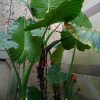
Colocasia esculenta ((L.) Schott)
-
Colocasia fallax (Schott)
-
Colocasia fontanesii (Schott)
-
Colocasia hassanii (H.Ara)
-
Colocasia kachinensis (S.S.Zhou & J.T.Yin)
-
Colocasia lihengiae (C.L.Long & K.M.Liu)
-
Colocasia mannii (Hook.f.)
-
Colocasia menglaensis (J.T.Yin, H.Li & Z.F.Xu)
-
Colocasia oresbia (A.Hay)
-
Colocasia spongifolia (P.J.Matthews, V.D.Nguyen, Q.Fang & C.L.Long)