
Genus Photinia in Family Rosaceae
In botanical taxonomy, a genus (plural genera) is a rank used to group closely related species within a family. In the hierarchy, genus sits below family and above species.
Genera are defined by shared morphological, anatomical, and genetic characteristics (for example, features of flowers, fruits, seeds, or leaves) that indicate a close evolutionary relationship among the species they contain.
Each genus can include one or more species. Examples include Rosa (roses) and Solanum (nightshades, including tomato and eggplant).
Do you wish to read more about plant taxonomy? Click here!
Genus Description
Suggest a correction!Photinia, a genus in Rosaceae (subfamily Amygdaloideae, tribe Maleae), comprises about 60–90 accepted species depending on treatment, with the type species commonly cited as Photinia serrulata (Lindley, 1821). The group is centered in eastern and southeastern Asia, ranging from the Himalayas to China, Korea, Japan, and Vietnam, with scattered occurrences as far as the Philippines and one species in Mexico. Members occupy subtropical to warm-temperate forests, thickets, and hillsides, often on limestone or other well-drained substrates.
The plants are evergreen or deciduous shrubs to small trees. Leaves are alternate, simple, and usually serrated, with prominent stipules that may fall early. Inflorescences are typically terminal corymbs or short panicles of numerous small, five-petaled, usually white flowers; sepals are early deciduous. Nectaries are present on the receptacle, and anthers are bilocular with longitudinal dehiscence. The ovary is typically half-inferior with usually five styles; fruits are small pomes that mature red to black, containing one to five seeds with cartilaginous endosperm.
Centers of diversity lie in South and Southwest China and northern Vietnam, with notable local endemism in southern China and Taiwan; the vegetation spans lowland forests to mid-elevations. Pollination is presumed by generalist insects; fruits are dispersed by birds.
Recent phylogenetic work places Photinia within Maleae, resolving long-recognized ties between Photinia and genera such as Heteromeles and Stranvaesia; these were historically treated as close and have been formally merged or re-circumscribed by some authors (WFO, 2024; International Rosaceae Working Group updates). Modern treatments consistently exclude the Mexican species from Photinia, retaining it in Heteromeles (Wen et al., 2008). Species limits remain unstable, particularly in China, where extensive synonymy has fluctuated across major floras (Flora of China, 2003; Zhou et al., 2018). Alternative placements and varying species totals reflect the unresolved taxonomy and lack of a recent monograph; POWO currently accepts many names but acknowledges pending revisions.
Photinia is widely cultivated in horticulture for hedges and screens, with P. serrulata and its hybrids especially common as evergreen ornamentals. It yields useful timber in some regions and, in East Asia, supports local horticulture for fruit production by selecting among wild types. Several taxa, particularly in southern China and Vietnam, face habitat loss, while imported ornamentals can naturalize and become problematic in non-native ranges; targeted risk assessments are limited.
Conservation and outlook: habitat fragmentation and taxonomic uncertainty impede effective protection and management; field-based revisions and phylogenomic studies are needed to stabilize nomenclature and guide conservation planning.
-
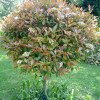
Photinia × fraseri (Dress)
-
Photinia anlungensis (T.T.Yu)
-
Photinia arbutifolia (Lindl.)
-
Photinia berberidifolia (Rehder & E.H.Wilson)
-
Photinia chihsiniana (K.C.Kuan)
-
Photinia chingiana (Hand.-Mazz.)
-
Photinia chingshuiensis ((T.Shimizu) T.S.Liu & H.J.Su)
-
Photinia chiuana (Z.H.Chen, Feng Chen & X.F.Jin)
-
Photinia crassifolia (H.Lév.)
-
Photinia cucphuongensis (T.H.Nguyên & Yakovlev)
-
Photinia davidiana (Cardot)
-
Photinia fokienensis (Franch. ex Cardot)
-
Photinia glabra ((Thunb.) Maxim.)
-
Photinia griffithii (Decne.)
-
Photinia hirsuta (Hand.-Mazz.)
2 -
Photinia impressivena (Hayata)
-
Photinia integrifolia (Lindl.)
1 -
Photinia lanuginosa (T.T.Yu)
-
Photinia lasiogyna ((Franch.) C.K.Schneid.)
-
Photinia lindleyana (Wight & Arn.)
-
Photinia lochengensis (T.T.Yu)
-
Photinia loriformis (W.W.Sm.)
-
Photinia megaphylla (T.T.Yu & L.T.Lu)
-
Photinia prionophylla (C.K.Schneid.)
-
Photinia prunifolia ((Hook. & Arn.) Lindl.)
-
Photinia pustulata (Lindl.)
-
Photinia serratifolia ((Desf.) Kalkman)
4 -
Photinia sorbifolia (W.B.Liao & W.Guo)
-
Photinia stenophylla (Hand.-Mazz.)
-
Photinia taishunensis (G.H.Xia, L.H.Lou & S.H.Jin)
-
Photinia tushanensis (T.T.Yu)
-
Photinia undulata (Cardot)
-
Photinia wrightiana (Maxim.)
-
Photinia zhejiangensis (P.L.Chiu)