
Genus Maclura in Family Moraceae
In botanical taxonomy, a genus (plural genera) is a rank used to group closely related species within a family. In the hierarchy, genus sits below family and above species.
Genera are defined by shared morphological, anatomical, and genetic characteristics (for example, features of flowers, fruits, seeds, or leaves) that indicate a close evolutionary relationship among the species they contain.
Each genus can include one or more species. Examples include Rosa (roses) and Solanum (nightshades, including tomato and eggplant).
Do you wish to read more about plant taxonomy? Click here!
Genus Description
Suggest a correction!Maclura (Nutt.) is a genus in Moraceae comprising trees and shrubs with milky latex that occur in the Americas, sub-Saharan Africa, and tropical Asia to Australia; Maclura amboinensis is the type species for the name. The genus is estimated to contain about twelve accepted species, with many additional names treated as synonyms, and its limits have been stabilized by recent phylogenetic work that places former segregates such as Cudrania and Icosanthus within Maclura (Datwyler & Weiblen, 2004; Zerega et al., 2005; Gardner et al., 2016; POWO, 2024; WFO, 2024). Plants are dioecious or occasionally monoecious and exhibit characteristic moraceous features: alternate to subopposite leaves with entire margins and interpetiolar stipules; inflorescences are dense heads or catkins that are unisexual and borne in axils, the staminate flowers with four tepals and four stamens, and the pistillate flowers with a syncarpous superior ovary often surmounted by a conspicuous style and usually possessing a single ovule per flower. Fruits are drupes densely aggregated on an enlarged receptacle; the mesocarp is often pulpy and the exocarp hard, which is typical for dispersal by frugivorous birds and mammals (Zerega et al., 2005; Gardner et al., 2016).
Diversity and centers are uneven: Maclura pomifera is native to the south-central United States, whereas Maclura tinctoria is widespread in the Neotropics and has been introduced in Africa and Asia; several additional species occur in tropical Africa and Asia, and some Australasian taxa previously treated in Cudrania are now included here (WFO, 2024; Zerega et al., 2005). Species are most common in forest edges, secondary growth, and savanna mosaics from near sea level to mid-elevations; geographic distributions reflect long-distance dispersal and multiple independent arrivals into both Old and New Worlds (Zerega et al., 2005).
Intrinsic biology is incompletely documented for most species, but the large, fleshy drupes of several taxa point to zoochorous dispersal, and field observations indicate visitation by birds and small mammals; reports of gall-making insects on Maclura species appear in earlier regional treatments, although systematic pollination studies are scarce. Chromosome counts have been reported in only a few taxa and remain insufficiently consolidated to support a robust genus-level base number without careful recension (Zerega et al., 2005).
Taxonomy and phylogeny place Maclura in the Moreae clade within Moraceae, where it is sister to Morus; extensive nomenclatural rearrangement over the past century has been resolved by molecular systematics that support the inclusion of Cudrania and other former segregates (Datwyler & Weiblen, 2004; Zerega et al., 2005; Gardner et al., 2016). Alternative treatments that restrict Maclura to North America and separate Cudrania are not supported by recent phylogenies, though checklists may lag in adopting the broadened circumscription; the name Maclura tinctoria continues to be used for the Neotropical source of fustic dye despite historical confusion with Chlorophora (Datwyler & Weiblen, 2004; Zerega et al., 2005; WFO, 2024).
Human relevance focuses on horticulture and timber: Maclura pomifera is widely planted for living fences and is naturalized in some temperate regions, while Maclura tinctoria has been valued for its durable, yellow heartwood (fustic) in furniture and specialty applications; several Asian taxa occur in secondary woodlands and provide local timber but are not major commercial timbers. Conservation concerns are localized and species-specific; data deficiencies and divergent taxonomy hinder assessment across much of the range. Continued integration of molecular phylogenetics with specimen-level biodiversity records will clarify species limits and inform conservation assessments (GBIF, 2024; WFO, 2024).
-
Maclura africana ((Bureau) Corner)
-
Maclura andamanica ((Hook.f.) C.C.Berg)
-
Maclura brasiliensis (Endl.)
-
Maclura cochinchinensis ((Lour.) Corner)
-
Maclura fruticosa ((Roxb.) Corner)
-
Maclura humbertii ((Leandri) Corner)
-
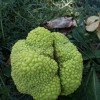
Maclura pomifera ((Raf.) C.K.Schneid.)
-
Maclura spinosa ((Willd.) C.C.Berg)
-
Maclura tinctoria ((L.) D.Don ex Steud.)
-
Maclura tricuspidata (Carrière)