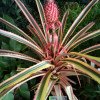
Genus Ananas in Family Bromeliaceae
In botanical taxonomy, a genus (plural genera) is a rank used to group closely related species within a family. In the hierarchy, genus sits below family and above species.
Genera are defined by shared morphological, anatomical, and genetic characteristics (for example, features of flowers, fruits, seeds, or leaves) that indicate a close evolutionary relationship among the species they contain.
Each genus can include one or more species. Examples include Rosa (roses) and Solanum (nightshades, including tomato and eggplant).
Do you wish to read more about plant taxonomy? Click here!
Genus Description
Suggest a correction!The genus Ananas (Bromeliaceae; Bromelioideae) comprises about three accepted species, with Ananas comosus being the cultivated pineapple (the family, order, and subfamily follow APG IV, 2016). It is native to tropical South America and has become naturalized across pantropical lowlands where warmth and high humidity prevail. In addition to A. comosus, wild taxa include A. bracteatus and A. ananassoides; together these span Brazil, Paraguay, and northern Argentina, with some populations extending to the Guianas (Bartholomew et al., 2003; Coppens d’Eeckenbrugge & Leal, 2001; POWO, 2024).
Plants are terrestrial rosettes with xerophytic, stiff, waxy leaves that are strongly toothed on the margins, an adaptation to water stress (Smith & Till, 1998). Stipules are absent. The inflorescence is a dense, terminal spike borne on a sturdy scape that elongates as the fruit matures, a “multiple” or aggregate fruit formed from numerous fused ovaries that lie within a fleshy inflorescence axis and are subtended by persistent, often brightly colored bracts that persist into fruit (Bartholomew et al., 2003; Smith & Till, 1998). The ovary is inferior, with axile placentation; each flower produces a fleshy fruitlet that fuses into the characteristic pineapple (Smith & Till, 1998).
Species richness concentrates in the Campos and Cerrado and Atlantic Forest of eastern and central Brazil, with several taxa exhibiting narrow endemism (e.g., A. bracteatus in southern Brazil and Paraguay). Ananas comosus is widely cultivated and pantropically naturalized, whereas A. ananassoides remains largely wild (Bartholomew et al., 2003; Coppens d’Eeckenbrugge & Lean, 2001). Habitats range from open savanna to forest margins and disturbed sites at low to mid elevations, where fire and seasonal drought shape demography (Bartholomew et al., 2003).
Pollination is primarily by hummingbirds, with nectar as the attractant, a classic adaptation to avian pollinators in Bromeliaceae (Smith & Till, 1998). Multiple fruits vary in seed production depending on cross-pollination and cultivar; natural seed dispersal is likely by animals that consume the fleshy infructescence (Bartholomew et al., 2003). Phenological timing tracks wet–dry transitions, aligning flowering with peak pollinator availability (Bartholomew et al., 2003).
Taxonomically, Ananas is recognized in modern treatments as comprising three species, with Pseudananas later submerged as a synonym of Ananas (Coppens d’Eeckenbrugge & Leal, 2001). Alternative circumscriptions have not gained broad acceptance; however, species limits within the wild group (especially the A. bracteatus–A. ananassoides complex) remain partly unresolved (Bartholomew et al., 2003; WFO, 2024).
Humans value A. comosus as a major fruit crop, with ornamental cultivars (variegated forms) widely planted and relatives occasionally used as ornamentals or fibre sources. The species is not considered invasive in natural ecosystems (Bartholomew et al., 2003; GBIF, 2024).
Conservation concerns are modest for cultivated lineages, but genetic erosion within cultivated A. comosus and habitat loss for wild species raise research priorities in germplasm conservation, domestication history, and clarifying species boundaries (Coppens d’Eeckenbrugge & Leal, 2001; GBIF, 2024).