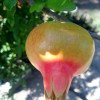
Genus Punica in Family Lythraceae
In botanical taxonomy, a genus (plural genera) is a rank used to group closely related species within a family. In the hierarchy, genus sits below family and above species.
Genera are defined by shared morphological, anatomical, and genetic characteristics (for example, features of flowers, fruits, seeds, or leaves) that indicate a close evolutionary relationship among the species they contain.
Each genus can include one or more species. Examples include Rosa (roses) and Solanum (nightshades, including tomato and eggplant).
Do you wish to read more about plant taxonomy? Click here!
Genus Description
Suggest a correction!Punica (authority L.) belongs to the family Lythraceae. It comprises two species: the widely cultivated pomegranate and the wild Socotran pomegranate. The genus is distributed naturally from the Mediterranean through the Middle East to the Indian subcontinent, with P. protopunica endemic to Socotra. Punica granatum is the type species of the genus.
Punica is distinguished by its opposite, simple leaves lacking stipules, axillary solitary or few-flowered clusters, and fleshy berries with numerous arillate seeds. Flowers have a tubular hypanthium bearing an epicalyx, numerous stamens inserted low on the hypanthium, and an inferior ovary. The fruit is a leathery-skinned berry with red pulp surrounding the seeds. The combination of opposite leaves, absence of true stipules, hypanthium with epicalyx, and numerous stamens consistently separates Punica from other Lythraceae.
Diversity centers on P. protopunica in Socotra and wild forms of P. granatum from Iran to northern India. Punica granatum thrives in seasonally dry subtropical to warm-temperate habitats on well-drained soils; wild populations occur near watercourses or on rocky slopes. Punica protopunica occupies rocky escarpments and gorges. Punica has become naturalized across similar climatic zones worldwide due to long cultivation, but its native range remains confined to the Western Asia–South Asia arc.
Pollination is primarily by insects, and dispersal is by birds and mammals that consume the fruit. Chromosome reports are inconsistent; many counts cluster around 2n=16, but counts up to 2n=24 have been recorded, indicating polyploidy and warranting further cytogenetic synthesis.
Taxonomically, Punica has long been treated as monogeneric at family rank (Punicaceae), but modern molecular evidence supports placement within Lythraceae; Graham et al. (2005) and APG updates accept this placement, and recent synthesis recognizes Punica as a distinct but nested lineage within the family. No further internal subdivision is consistently applied.
Human relevance is horticultural and ornamental; Punica granatum is cultivated for fruit and as a landscape shrub valued for showy flowers, while dwarf forms are used in containers. Timber is locally used; some accessions are weedy in Mediterranean climates. Punica protopunica is assessed as endangered due to habitat degradation and limited range.
Conspicuous research gaps include clear native limits of P. granatum, cytogenetic clarification, and long-term viability monitoring of P. protopunica. In light of climate change and habitat pressures, targeted ex situ conservation and population genomics will be essential for both species (POWO, 2024; WFO, 2024; APG IV, 2016; Graham et al., 2005).