
Hibiscus trionum
Table of Contents
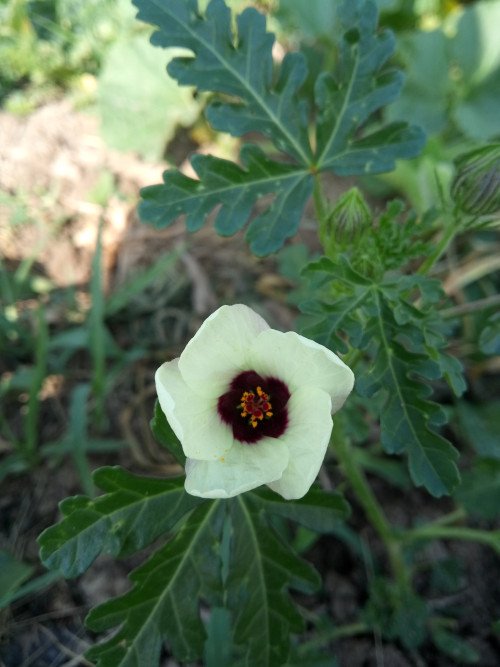
Details Top
| Internal ID | UUID644020aa060c3384293741 |
| Scientific name | Hibiscus trionum |
| Authority | L. |
| First published in | Sp. Pl. : 697 (1753) |
General Uses Top
Suggest a correction!Common products:
Hibiscus trionum is cultivated almost exclusively as an ornamental flowering plant. Commercial horticultural firms produce and sell seeds, seedlings, and potted plants for use in cottage‑garden beds, mixed borders, and container displays. The species is also marketed as a cut flower for short‑term floral arrangements because the large, showy corolla remains attractive after cutting. Seed catalogs of major distributors list the species alongside other annual hibiscus varieties, and plant nurseries routinely carry stock for the spring planting season.
Industrial and craft applications:
The papery calyx that remains on the plant after petal drop is harvested in small quantities for dried‑flower crafts such as wreaths and decorative garlands. Dried flower material is supplied by specialty craft suppliers who source it from cultivated stock, providing a minor but documented non‑medicinal use.
Properties relevant to use:
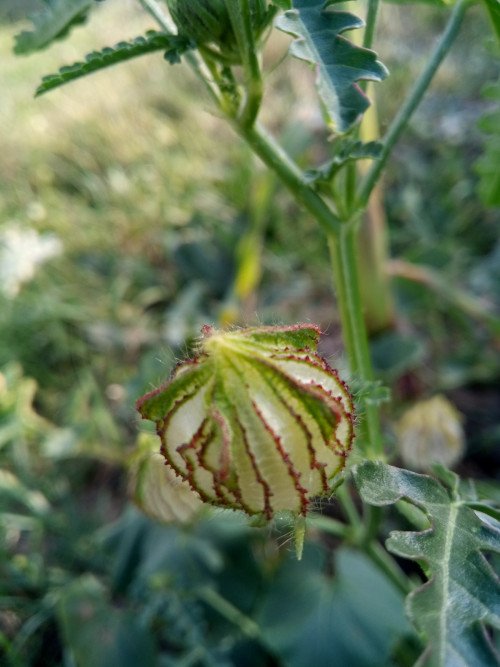
Ornamental value stems from the long‑lasting, five‑petaled flowers (typically white to pale pink with a deep maroon throat) and a conspicuous papery calyx that persists after anthesis, extending visual interest. The plant exhibits an upright, branched habit reaching 30–70 cm, tolerates soils ranging from sandy loam to moderately fertile clay, and thrives in full sun to partial shade. It produces rapid vegetative growth, completing a full flowering cycle within a single season, and shows moderate drought tolerance that reduces irrigation needs in commercial production. Seeds display high germination rates (often >80 % under optimal conditions) and retain viability for several years, facilitating cost‑effective seed propagation. The calyx’s papery texture and durability make it suitable for dried‑flower crafts.
Standards and regulation:
Seeds marketed in the United States must comply with the Federal Seed Act, which requires accurate labeling of species, cultivar, and germination percentages. In the European Union, seed sales are governed by the Plant Reproductive Material Directive, which mandates certification under the OECD Seed Certification Scheme for commercial seed lots. These regulatory frameworks ensure traceability and quality standards for horticultural products of H. trionum.
Sustainability and sourcing:
Hibiscus trionum is cultivated entirely from domesticated stock and readily self‑sows, so commercial production does not depend on wild harvest and poses no threat to wild populations. The species is listed as “secure” in regional plant databases (e.g., USDA PLANTS) and is classified as non‑invasive in most temperate zones. Growers report low pest pressure and minimal chemical inputs, contributing to an environmentally benign production profile. Seed suppliers source material from certified breeding programs that maintain genetic purity, ensuring consistent ornamental quality while supporting sustainable horticultural practices. No CITES export permits are required, and the plant is not considered a conservation concern.
Synonyms Top
| Scientific name | Authority | First published in |
|---|---|---|
| Laguna ternata | Willd. | Sp. Pl., ed. 4 , 3: 733 (1800) |
| Trionum cordifolium | Moench | Suppl. Meth. : 202 (1802) |
| Trionum diffusum | Moench | Methodus : 618 (1794) |
| Trionum frutescens | Medik. | Malvenfam. : 47 (1787) |
| Abelmoschus collinsianus | Wood | Class-book Bot. , ed. 2b: 271 (1861) |
| Hibiscus dissectus | Wall. | Numer. List [Wallich] n. 2696. 1831 |
| Hibiscus djabinianus | Parsa | Kew Bull. 2: 18 (1947) |
| Hibiscus hastifolius | E.Mey. ex Harv. & Sond. | Fl. Cap. 1: 176 (1860) |
| Hibiscus humboldtii | Schrank ex Colla | Hortus Ripul. , App. 2: 349 (1826) |
| Hibiscus humboldtii | hort. ex Fisch. & C.A.Mey. | Index Seminum (LE, Petropolitanus) 6: 52 (1840) |
| Hibiscus marchallianus | hort. ex Fisch. & Mey | Index Seminum (LE, Petropolitanus) 9: 76 (1843) |
| Hibiscus pallidus | Raf. ex S.Watson | Bibl. Index N. Amer. Bot. : 135 (1878) |
| Hibiscus physodes | E.Mey. ex Harv. & Sond. | Fl. Cap. 1: 176 (1860) |
| Hibiscus trionum var. cordifolius | DC. | Prodr. 1: 453 (1824) |
| Hibiscus uniflorus | E.Mey. ex Harv. & Sond. | Fl. Cap. 1: 176 (1860) |
| Hibiscus vesicarius | Cav. | Diss. 3: 171 (1787) |
| Trionum annuum | Medik. | Malvenfam. : 47 (1787) |
| Hibiscus africanus | Mill. | Gard. Dict. ed. 8 : n.º 20 (1768) |
| Hibiscus hispidus | Mill. | Gard. Dict. ed. 8 : n.º 21 (1768) |
| Hibiscus ternatus | Cav. | Diss. 3: 172 (1787) |
| Ketmia trionum | (L.) Scop. | Fl. Carniol. , ed. 2, 2: 44 (1772) |
| Hibiscus trionum var. vesicarius | Hochr. | Annuaire Conserv. Jard. Bot. Genève 4: 145 (1900) |
| Trionum trionum | Wooton & Standl. | Contr. U.S. Natl. Herb. 19: 417. 1915 |
| Hibiscus armeniacus | Bouché | Allg. Gartenzeitung 8: 403 (1840) |
| Hibiscus cuneifolius | Garcke | Bot. Zeitung (Berlin) 7: 852. 1849 |
| Hibiscus trionicus | St.-Lag. | Ann. Soc. Bot. Lyon vii. (1880) 127. |
| Hibiscus trionum var. vesicarius | (Cav.) Hochr. | Annuaire Conserv. Jard. Bot. Genève 4: 145. 1900 |
| Hibiscus trionum var. ternatus | DC. |
Common names Top
Add a new one! Suggest a correction!| Language | Common/alternative name |
|---|---|
| English | puarangi |
| English | modesty |
| English | flower-of-the-hour |
| English | bladder weed |
| English | bladder ketmia |
| English | bladder hibiscus |
| English | flower-of-an-hour |
| English | flower of an hour |
| English | shoofly |
| English | venice mallow |
| Afrikaans | terblansbossie |
| Arabic | خطمي إفريقي |
| Azerbaijani | Üçlü hibiskus |
| Czech | ibišek trojdílný |
| Welsh | cetmia chwysigennog |
| German | stundenblume |
| Estonian | kolmetine hibisk |
| Persian | ختمی سه رنگ |
| Finnish | ajannäyttäjä |
| Finnish | ajannäyttäjähibiskus |
| Upper Sorbian | Žołta hodźinka |
| Hungarian | varjúmák |
| Hungarian | dinnyefű |
| Armenian | բամբակաղբեր ուռած |
| Korean | 수박풀 |
| mi | puarangi |
| Macedonian | меуреста слезовина |
| Malayalam | ഹൈബിസ്കസ് ട്രൈയോണം |
| Norwegian Bokmål | timerose |
| Dutch | uurbloem |
| Dutch | drie-urenbloem |
| Portuguese | flor-de-todas-as-horas |
| Romanian | zămoșiță |
| Russian | Гибискус северный |
| Russian | Гибискус тройчатый |
| Slovenian | navadni oslez |
| Swedish | timvisare |
| Tamil | ஒருமணி நேரப் பூ |
| Uzbek | boʻritaroq |
| Chinese | 黑芝麻 |
| Chinese | 香铃草 |
| Chinese | 火炮草 |
| Chinese | 小秋葵 |
| Chinese | 野西瓜苗子 |
| Chinese | 野西瓜苗 |
| Chinese | 灯笼花 |
Germination/Propagation Top
Suggest a correction or add new data!| Sow seeds at 20°C, expecting germination within 3 months without further temperature treatment. |
| Requires Darkness: These seeds need to be covered with soil or otherwise kept in the dark to germinate properly. Light inhibits their germination process. |
| Requires Scarification: Scarification involves physically breaking, scratching, or softening the seed coat to allow water absorption and germination to occur. This can be done by nicking the seed coat with a knife or rubbing the seeds between sheets of sandpaper. |
| Requires Soaking: These seeds need to be soaked in warm water until they swell, which can take 24-48 hours. Seeds that float are usually not viable and should be discarded, along with the soaking water. |
Distribution (via POWO/KEW) Top
Legend for the distribution data:
- Doubtful data
- Extinct
- Introduced
- Native
-
Africa click to expand
-
Northern Africa
- Algeria
- Libya
- Morocco
- Tunisia
-
Western Indian Ocean
- Mauritius
-
Northern Africa
-
Asia-temperate click to expand
-
Caucasus
- North Caucasus
- Transcaucasus
-
China
- China North-central
- China South-central
- China Southeast
- Hainan
- Inner Mongolia
- Manchuria
- Tibet
- Xinjiang
-
Eastern Asia
- Japan
- Korea
- Taiwan
-
Middle Asia
- Kazakhstan
- Kirgizstan
- Tadzhikistan
- Turkmenistan
- Uzbekistan
-
Mongolia
- Mongolia
-
Russian Far East
- Amur
- Primorye
-
Siberia
- Chita
- Irkutsk
-
Western Asia
- Afghanistan
- Cyprus
- Iran
- Iraq
- Lebanon-Syria
- Palestine
- Turkey
-
Caucasus
-
Asia-tropical click to expand
-
Indian Subcontinent
- Assam
- Bangladesh
- Pakistan
- West Himalaya
-
Indo-China
- Myanmar
-
Indian Subcontinent
-
Australasia click to expand
-
New Zealand
- New Zealand North
- New Zealand South
-
New Zealand
-
Europe click to expand
-
Eastern Europe
- Krym
- South European Russia
- Ukraine
-
Middle Europe
- Austria
- Belgium
- Czechoslovakia
- Germany
- Hungary
- Poland
-
Northern Europe
- Great Britain
-
Southeastern Europe
- Albania
- Bulgaria
- Greece
- Italy
- Kriti
- Romania
- Sicilia
- Turkey-in-Europe
- Yugoslavia
-
Southwestern Europe
- France
- Portugal
- Spain
-
Eastern Europe
-
Northern America click to expand
-
Eastern Canada
- New Brunswick
- Nova Scotia
- Ontario
- Prince Edward Island
- Québec
-
North-central U.S.A.
- Illinois
- Iowa
- Kansas
- Minnesota
- Missouri
- Nebraska
- North Dakota
- Oklahoma
- South Dakota
- Wisconsin
-
Northeastern U.S.A.
- Connecticut
- Indiana
- Maine
- Massachusetts
- Michigan
- New Hampshire
- New Jersey
- New York
- Ohio
- Pennsylvania
- Rhode Island
- Vermont
- West Virginia
-
Northwestern U.S.A.
- Colorado
- Idaho
- Montana
- Oregon
- Washington
- Wyoming
-
South-central U.S.A.
- New Mexico
- Texas
-
Southeastern U.S.A.
- Alabama
- Arkansas
- Delaware
- District Of Columbia
- Florida
- Georgia
- Kentucky
- Louisiana
- Maryland
- Mississippi
- North Carolina
- South Carolina
- Tennessee
- Virginia
-
Southwestern U.S.A.
- Arizona
- California
- Utah
-
Western Canada
- Manitoba
- Saskatchewan
-
Eastern Canada
-
Pacific click to expand
-
Southwestern Pacific
- New Caledonia
-
Southwestern Pacific
-
Southern America click to expand
-
Caribbean
- Cuba
- Jamaica
-
Southern South America
- Chile Central
- Uruguay
-
Caribbean
Links to other databases Top
Suggest others/fix!| Database | ID/link to page |
|---|---|
| World Flora Online | wfo-0000723167 |
| Florida Plant Atlas | 1948 |
| Flora of Alabama | 2622 |
| Canadensys | 6622 |
| USDA Plants | HITR |
| Tropicos | 19600999 |
| INPN | 101546 |
| Flora of Italy | 3137 |
| KEW | urn:lsid:ipni.org:names:122028-2 |
| The Plant List | kew-2850654 |
| Missouri Botanical Garden | 282594 |
| Open Tree Of Life | 120915 |
| NCBI Taxonomy | 183268 |
| NBN Atlas | NBNSYS0000014582 |
| Nature Serve | 2.132403 |
| IPNI | 122028-2 |
| iNaturalist | 77411 |
| GBIF | 3152560 |
| Freebase | /m/071ytq |
| WisFlora | 3846 |
| EPPO | HIBTR |
| EOL | 584352 |
| Elurikkus | 5080 |
| Calflora (Californian flora) | 4183 |
| USDA GRIN | 19098 |
| Wikipedia | Hibiscus_trionum |
Genomes (via NCBI) Top
Below is displayed the reference genome only!
If you wish to browse all genomes for this plant click here.
If you wish to browse all genomes for this plant click here.
| Accession | Assembly | |||||
|---|---|---|---|---|---|---|
| Name | Level | Submitter | Released | Coverage | Size | |
| GCA_030270665.1 | Htrionum_1.0 | Contig | Biological Networks Laboratory, National Institute of Genetics | 2023-05-27 | 20 | 1.56 Gb |
Scientific Literature Top
Below are displayed the latest 15 articles published in PMC (PubMed Central®) and other sources (DOI number only)!
If you wish to see all the related articles click here.
If you wish to see all the related articles click here.
Phytochemical Profile Top
Add a new one!
No natural compounds are linked yet. If you wish to help please use this tool.

Collections Top
| In private collections | 0 |
| In public collections | 1 |