
Genus Ceratonia in Subfamily Caesalpinioideae
In botanical taxonomy, a genus (plural genera) is a rank used to group closely related species within a family. In the hierarchy, genus sits below family and above species.
Genera are defined by shared morphological, anatomical, and genetic characteristics (for example, features of flowers, fruits, seeds, or leaves) that indicate a close evolutionary relationship among the species they contain.
Each genus can include one or more species. Examples include Rosa (roses) and Solanum (nightshades, including tomato and eggplant).
Do you wish to read more about plant taxonomy? Click here!
Genus Description
Suggest a correction!Ceratonia L. belongs to the Fabaceae family (subfamily Caesalpinioideae) and is essentially monotypic, containing only the cultivated carob, Ceratonia siliqua L., as its accepted species (POWO, 2024; WFO, 2024). The type species is C. siliqua, designated by Linnaeus (1753). The tree occurs throughout the Mediterranean basin and has been introduced to similar warm‑dry regions worldwide.
Diagnostic traits include an evergreen habit up to 10–15 m tall, alternate paripinnate leaves bearing 1–3 pairs of thick, leathery leaflets that are entire and glabrous; caducous stipules are small. Flowers are unisexual, arranged in axillary racemes, and lack petals, having only five small sepals; male flowers possess five exserted stamens, females a single ovate ovary. The fruit is a large indehiscent legume (pod) up to 20 cm long, fleshy, sweet and contains 5–10 hard seeds. Seeds are noted for their uniform weight, historically used as a unit of mass. Chromosome number is 2n = 24 (Krebs, 1995).
Diversity is low; the genus is treated as monotypic in most modern treatments, though several subspecies and cultivars of C. siliqua are recognized. Endemism is limited to the Mediterranean, where the carob occupies dry maquis, rocky slopes and coastal dunes from sea level to roughly 800 m elevation. It thrives in semi‑arid climates with winter rainfall and a pronounced summer drought.
Intrinsic biology: pollination is primarily anemophilous, the small, non‑showy flowers releasing abundant pollen that is dispersed by wind. Seed dispersal is by mammals and birds that consume the sweet pod, while the hard seed coat protects the embryo through the dry season.
Taxonomy and phylogeny: Ceratonia is placed in tribe Cassieae of the Caesalpinioideae (Lewis et al., 2005). Recent phylogenomic analyses (LPWG, 2017) confirm its position within the early‑diverging Caesalpinioideae clade, sister to a group containing Dialium and Koompassia. Some historical treatments expanded the genus to include fossil species, but contemporary circumscriptions restrict it to C. siliqua (POWO, 2024).
Human relevance: C. siliqua is cultivated for its edible pods, used as a chocolate substitute, animal feed and source of carob gum; the wood is valued for furniture and ornamental planting. No medicinal claims are made here.
Conservation: the species is widespread and listed as Least Concern by the IUCN; however, habitat loss in native Mediterranean regions and climate change pose future risks, underscoring the need for continued ex situ preservation and genetic studies.
-
Ceratonia oreothauma (Hillc., G.P.Lewis & Verdc.)
2 -
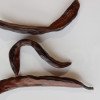
Ceratonia siliqua (L.)