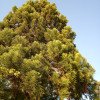
Genus Cryptomeria in Family Cupressaceae
In botanical taxonomy, a genus (plural genera) is a rank used to group closely related species within a family. In the hierarchy, genus sits below family and above species.
Genera are defined by shared morphological, anatomical, and genetic characteristics (for example, features of flowers, fruits, seeds, or leaves) that indicate a close evolutionary relationship among the species they contain.
Each genus can include one or more species. Examples include Rosa (roses) and Solanum (nightshades, including tomato and eggplant).
Do you wish to read more about plant taxonomy? Click here!
Genus Description
Suggest a correction!Cryptomeria D.Don is a monotypic genus in the Cupressaceae family comprising only Cryptomeria japonica (Thunb. ex L.f.) D.Don, the Japanese cedar (POWO, 2024; WFO, 2024). This relictual conifer ranges approximately 1.2 million years in evolutionary age (Chun et al., 2015). The species demonstrates substantial intraspecific variation, with three varieties generally recognized: var. japonica (Japan), var. sinensis (China), and var. elegans (Taiwan and southeastern China). Distribution spans broadleaved and mixed forests from sea level to 2,700 meters elevation across temperate to subtropical eastern Asia.
Morphologically, Cryptomeria exhibits the characteristic Cupressaceae architecture: pyramidal juvenile habit transitioning to broadly columnar in mature trees, with reddish-brown fibrous bark exfoliating in strips. The ultimate branchlets bear scale-like leaves arranged in whorls of three, with each needle 0.3-1.5 cm long, slightly curved forward, bearing two stomatal bands and ending in an acute apex. The monoecious reproductive system produces small pollen cones (2-5 mm) in terminal clusters and ovulate cones (1-1.5 cm diameter) maturing in two years from late summer to autumn. The mature seed cones are globose with 20-30 woody scales, each bearing 2-5 narrowly winged seeds (Flora of China Editorial Committee, 1999).
The genus displays remarkable diversity centers, with genetic studies revealing three distinct lineages: Japanese populations, Chinese mainland varieties, and Taiwanese populations (Chun et al., 2015). Taiwanese var. elegans exhibits particularly distinctive morphology and genetics. Primary habitats include montane forests, where it associates with broadleaf species, and coastal forests in milder climates. Despite its extensive cultivation, natural populations face habitat fragmentation and climate change pressures.
Cryptomeria exhibits wind pollination typical of Cupressaceae, with mature pollen shed occurring during winter months. Seed dispersal involves the cone's persistent woody scales releasing seeds upon natural weathering. Chromosome count is consistently documented as 2n = 22, indicating a base number of x = 11 (Matsuzaki et al., 1998).
Taxonomically, Cryptomeria belongs to the Cupressoideae subfamily, closely related to Sequoia and Metasequoia based on molecular phylogenies (Mao et al., 2012; Farjon, 2010). Some authors have historically suggested recognizing Cryptomeria as a subgenus within Sequoia, but molecular evidence strongly supports maintaining generic status (Chun et al., 2015). The species has undergone minimal taxonomic re-circumscription, with Cryptomeria fortunei and Cryptomeria kawaii now treated as synonyms of C. japonica.
Human significance encompasses ornamental horticulture, where cultivars dominate horticultural markets, and sustainable timber production. Japanese cedar ranks among Japan's most important commercial timber species. The species exhibits invasive potential in non-native regions where seedlings establish readily in disturbed habitats (Queensland Government, 2022).
Conservation concerns focus on genetic erosion within fragmented populations, particularly in China where deforestation pressures threaten var. sinensis. Research gaps persist in understanding long-term reproductive dynamics and adaptive potential under climate change scenarios.