
Genus Larrea in Family Zygophyllaceae
In botanical taxonomy, a genus (plural genera) is a rank used to group closely related species within a family. In the hierarchy, genus sits below family and above species.
Genera are defined by shared morphological, anatomical, and genetic characteristics (for example, features of flowers, fruits, seeds, or leaves) that indicate a close evolutionary relationship among the species they contain.
Each genus can include one or more species. Examples include Rosa (roses) and Solanum (nightshades, including tomato and eggplant).
Do you wish to read more about plant taxonomy? Click here!
Genus Description
Suggest a correction!Larrea (Cav.) is a small evergreen shrub genus in the family Zygophyllaceae (POWO, 2024; WFO, 2024). It comprises about five species, the type species being Larrea tridentata (Turner & Barneby, 2016). The genus ranges across the warm deserts of North and South America, from the Mojave and Sonoran deserts of the southwestern United States and northern Mexico to the Monte and Patagonian deserts of Argentina and Chile (Turner & Barneby, 2016). Species occupy arid scrub and semi‑desert habitats from sea level to roughly 2 500 m, often on limestone or sandy soils.
Morphologically, Larrea bears opposite, bifoliolate leaves with fused leaflets, a thick resinous cuticle and early‑deciduous stipules. Inflorescences are solitary or small axillary clusters of yellow to cream flowers with five sepals, five petals and ten stamens in two whorls. The superior, five‑carpellate ovary has axile placentation and matures into a five‑winged schizocarp that splits into winged mericarps for wind dispersal (Turner & Barneby, 2016). The resinous leaf surface and distinctive fruit separate the genus from related Zygophyllaceae.
Diversity centres in the arid American Southwest for L. tridentata; South American species include L. divaricata, L. nitida, L. ameghinoi and L. constricta (POWO, 2024). Endemism is high in the Monte Desert, and the disjunct North–South American distribution reflects ancient vicariance (Johnson et al., 2020).
Intrinsic biology notes primary bee pollination, occasional wind assistance, long‑lived clonal reproduction by root sprouting, and a base chromosome number x = 14 (2n = 28) reported for L. tridentata (Ortiz et al., 2015). Leaf resin deters herbivores and contributes to drought tolerance.
Taxonomically, Larrea occupies tribe Larreeae. Molecular phylogenies confirm monophyly (Johnson et al., 2020). Historical sectional divisions recognize Larrea sect. Larrea for North American taxa and Larrea sect. Divaricata for South American taxa (Turner & Barneby, 2016). Formerly, South American species were treated as a separate genus Angostura, but current databases synonymise them within Larrea (WFO, 2024).
Human relevance is mainly horticultural; the genus is a popular drought‑tolerant ornamental in xeriscaping and restoration plantings. It provides resin used traditionally, but no medicinal applications are claimed here. No species are listed as globally invasive, though local establishment can occur in disturbed sites.
Conservation concerns centre on climate change, habitat fragmentation and limited IUCN assessments. Continued phylogenetic and population‑genomic research is needed to guide management (Johnson et al., 2020).
-
Larrea ameghinoi (Speg.)
-
Larrea cuneifolia (Cav.)
-
Larrea divaricata (Cav.)
-
Larrea nitida (Cav.)
-
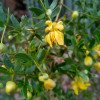
Larrea tridentata ((DC.) Coville)