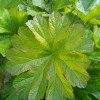
Genus Darmera in Family Saxifragaceae
In botanical taxonomy, a genus (plural genera) is a rank used to group closely related species within a family. In the hierarchy, genus sits below family and above species.
Genera are defined by shared morphological, anatomical, and genetic characteristics (for example, features of flowers, fruits, seeds, or leaves) that indicate a close evolutionary relationship among the species they contain.
Each genus can include one or more species. Examples include Rosa (roses) and Solanum (nightshades, including tomato and eggplant).
Do you wish to read more about plant taxonomy? Click here!
Genus Description
Suggest a correction!Darmera is a monotypic genus in Saxifragaceae comprising Darmera peltata (Torr. ex Benth.) Voss (POWO, 2024; WFO, 2024). It is a rhizomatous, herbaceous perennial of stream margins and seeps in the Pacific Northwest, ranging from the southern Klamath and northern Sierra Nevada mountains into the Cascade Range of northern California and Oregon (Flora of North America, 2017). The species is well established, and no closely allied species are currently accepted.
The plant is recognized by emergent, leafless scapes bearing compact, spherical, compound inflorescences that appear before the large, peltate, palmately lobed leaves unfold. Flowers are small, with five greenish to white petals; the ovary is inferior and bilocular with axile placentation (Flora of North America, 2017). The fruit is a many-seeded capsule (Flora of North America, 2017). This leaf-before-flower phenology and peltate blade distinguish Darmera from most other saxifragaceous genera.
Biogeographically, Darmera is centered in the Pacific coast mountains of the United States, with occasional outlying populations (Jepson eFlora, 2012). It occupies cool, moist, shaded to semi-shaded sites along perennial streams, springs, and seepage lines, typically at low to middle elevations. The narrow distribution and preference for riparian habitats shape its conservation profile.
Pollination and dispersal are not comprehensively documented; the flower morphology is consistent with insect-mediated pollination, and capsule dehiscence suggests at least local wind-assisted seed movement, but published synthesis remains limited. The genus is monotypic and has not been subdivided into subgenera or sections.
In Saxifragaceae, Darmera falls within the broad Saxifragoideae clade as circumscribed by recent phylogenies (Soltis et al., 1996; 2015). The name Darmera has been widely adopted over historical usage of Peltiphyllum; the latter remains a recognized synonym in some treatments (Flora of North America, 2017; WFO, 2024), with genus delimitation stable at present (POWO, 2024).
The species is widely cultivated for its dramatic foliage and spring floral scapes, valuable in riparian and woodland gardens and naturalized in suitable climates (Flora of North America, 2017). It is not a crop or timber species and poses no significant weed or invasive problems. Primary conservation concerns relate to hydrological alteration of stream habitats; monitoring of population trends and habitats remains advisable (Flora of North America, 2017).