
Genus Bouea in Family Anacardiaceae
In botanical taxonomy, a genus (plural genera) is a rank used to group closely related species within a family. In the hierarchy, genus sits below family and above species.
Genera are defined by shared morphological, anatomical, and genetic characteristics (for example, features of flowers, fruits, seeds, or leaves) that indicate a close evolutionary relationship among the species they contain.
Each genus can include one or more species. Examples include Rosa (roses) and Solanum (nightshades, including tomato and eggplant).
Do you wish to read more about plant taxonomy? Click here!
Genus Description
Suggest a correction!Bouea (Meisn.) is a small genus of the cashew family, Anacardiaceae, comprising approximately five species of evergreen trees native to tropical Southeast Asia. The type species of the genus is Bouea oppositifolia (Roxb.) Meisn., while the most widely cultivated species, Bouea macrophylla Griffith (gandaria), is used for its edible drupes (POWO, 2024; WFO, 2024).
The trees reach 20–30 m, with simple, opposite, leathery leaves that are glabrous to sparsely pubescent; young shoots bear a fine reddish indumentum and small, quickly deciduous stipules. Inflorescences are axillary or terminal panicles with numerous small, five‑parted flowers; the perianth has free creamy petals, a short calyx, a reduced disc, a superior monocarpellary ovary with a basal ovule, and fruits are ovoid to ellipsoid drupes with a thin exocarp, fleshy mesocarp, and a hard endocarp containing a solitary seed.
Bouea is centred in the Malesian region, ranging from Myanmar and Thailand to Malaysia, Indonesia (Sumatra, Java, Borneo) and the Philippines, occupying lowland to lower‑montane rain forests, often riverine or secondary, up to 1,200 m. Endemism is highest on the Malay Peninsula and Borneo, where several taxa are locally restricted (Mitchell & Pell, 2022).
Pollination has been observed by small flies and bees, and fruits are dispersed by birds and mammals. Chromosome numbers for the genus remain unconfirmed, although related Anacardiaceae show a base number of x = 14 (Pell et al., 2021).
In current classifications Bouea is placed in subtribe Mangiferinae of tribe Rhoeae. Phylogenetic analyses (Pell et al., 2021) confirm its monophyly and sister relationship to Mangifera, supporting generic separation; some authors have suggested synonymising Bouea under Mangifera (Mitchell & Pell, 2022), but the prevailing consensus retains it as distinct (WFO, 2024). No formal subgeneric sections are recognised.
Bouea macrophylla is the main horticultural species, its fruit consumed fresh, in sauces, jams and preserves; its timber is used locally for light construction. Other species are of botanical interest and are not considered invasive.
Habitat loss from deforestation is the primary threat; a few taxa are listed as Near Threatened regionally, and ex situ collections are limited (WFO, 2024). Continued field surveys and cultivation of the fruit tree in diversified agro‑forestry systems will be essential to safeguard the genetic resources of this tropical genus.
-
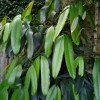
Bouea macrophylla (Griff.)
-
Bouea oppositifolia ((Roxb.) Adelb.)
-
Bouea poilanei (Evrard)