
Genus Wisteria in Subfamily Papilionoideae
In botanical taxonomy, a genus (plural genera) is a rank used to group closely related species within a family. In the hierarchy, genus sits below family and above species.
Genera are defined by shared morphological, anatomical, and genetic characteristics (for example, features of flowers, fruits, seeds, or leaves) that indicate a close evolutionary relationship among the species they contain.
Each genus can include one or more species. Examples include Rosa (roses) and Solanum (nightshades, including tomato and eggplant).
Do you wish to read more about plant taxonomy? Click here!
Genus Description
Suggest a correction!Wisteria, named by Nuttall and typified by Wisteria frutescens, belongs to Fabaceae subfamily Faboideae (APG IV, 2016). About ten species comprise the genus, native to eastern Asia (China, Japan, Korea) and the southeastern United States, with occasional forms widely cultivated elsewhere. Wisterias are robust woody climbers reaching tens of meters, their stems twisting clockwise; bark is typically smooth or shallowly ridged. Leaves are alternate, imparipinnate with numerous leaflets; leaflets are entire, ovate to lanceolate, and often glabrous above with sparse indumentum beneath. Stipules are small and caducous. Inflorescences are pendulous racemes borne terminally or in leaf axils; buds open sequentially from the base toward the tip over several days. Flowers are papilionaceous, white to lavender or violet, with a prominently reflexed banner, boatlike keel, and free stamens. Nectaries are annular at the base of the hypanthium. Fruits are flattened legumes that are initially fleshy but dry and become papery to leathery at maturity, eventually splitting to expose several hard, ovoid seeds.
Species richness centers in China, notably Sichuan and the Three Gorges region, and Japan, with additional diversity in Korea and the southeastern United States. In East Asia, wisterias occur in mixed forests, forest margins, and riparian corridors up to moderate elevations; in the United States, W. frutescens and W. macrostachya occupy bottomlands and swamp margins. Several species are narrow endemics and regionally common.
Pollination is mainly by bees collecting nectar and pollen, with occasional hawkmoth visitation noted in the literature; advanced cultivars are largely self-fertile. Seeds are explosively ejected from mature pods and are also dispersed by water and birds (Lewis et al., 2005). Chromosome counts of x=8, 2n=16 are widely reported and consistent across taxa.
Two informal subgeneric lineages are often recognized: the East Asian group centered on W. sinensis and W. floribunda, and the North American group (W. frutescens, W. macrostachya). Traditional treatments segregate the American taxa under Kraunhovia or Wisteria subg. Kraunhovia (Lewis et al., 2005; 2013), while POWO (2024) places these names in synonymy under Wisteria s.l.; W. macrostachya is variably treated at specific or varietal rank relative to W. frutescens (USDA PLANTS, 2024). Molecular work (Li et al., 2008) supports monophyly of these lineages and clarifies species relationships.
Wisterias are iconic ornamentals with a long horticultural history, producing spectacular racemes; cultivars such as W. sinensis ‘Prolific’ and W. frutescens ‘Amethyst Falls’ are particularly popular. Vines are used for arbors and pergolas; some species and cultivars are aggressive and can escape cultivation, forming thickets on walls and in ruderal habitats. Seed and seedling sale is regulated in some jurisdictions.
Several East Asian taxa have restricted ranges and are vulnerable to habitat loss. Gaps remain in population-level data across parts of China and in robust phylogenetic resolution for closely allied species. Continued long-term monitoring and phylogenomic studies will be essential to guide conservation and informed horticultural use.
-
Wisteria × formosa (Rehder)
-
Wisteria brachybotrys (Siebold & Zucc.)
-
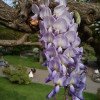
Wisteria floribunda ((Willd.) DC.)
1 -
Wisteria frutescens ((L.) Poir.)
2 -
Wisteria sinensis ((Sims) DC.)
-
Wisteria valderi (J.Compton)
-
Wisteria ventusa (Rehder & Wils.)