
Genus Weigela in Family Caprifoliaceae
In botanical taxonomy, a genus (plural genera) is a rank used to group closely related species within a family. In the hierarchy, genus sits below family and above species.
Genera are defined by shared morphological, anatomical, and genetic characteristics (for example, features of flowers, fruits, seeds, or leaves) that indicate a close evolutionary relationship among the species they contain.
Each genus can include one or more species. Examples include Rosa (roses) and Solanum (nightshades, including tomato and eggplant).
Do you wish to read more about plant taxonomy? Click here!
Genus Description
Suggest a correction!Within the family Diervilliaceae (often treated as Caprifoliaceae subfamily Diervilloideae; APG IV, 2016), Weigela (Thunb.) is a small genus of about ten species of deciduous shrubs native to temperate East Asia, from Japan and the Korean Peninsula through northeastern China to the Russian Far East, where they occupy forest margins, thickets and mountain slopes. The type species is Weigela coraeensis Thunb., described from Japan (POWO, 2024; WFO, 2024).
Plants have opposite, simple leaves with serrate margins and no stipules; leaves are ovate‑lanceolate and often turn yellow in autumn. Flowers are solitary or in small dichasial clusters; each has a funnel‑shaped corolla with five spreading lobes, usually pink to white, and a five‑lobed calyx. The inferior, bicarpellary ovary bears a two‑lobed stigma and matures into a septicidal capsule that splits into two valves bearing many small winged seeds.
Species richness is highest in the Sino‑Japanese floristic region, with narrow endemics on islands and mountains; for instance, Weigela koreana is confined to Korea and Weigela subcordata to southwestern China. Shrubs occur from lowland forest edges to about 2000 m in montane scrub. Phylogeographic analyses identify three major clades roughly matching Japanese‑Korean, northeastern Chinese and southern Chinese lineages (Kim et al., 2020), reflecting historic vicariance and post‑glacial spread.
Pollination is mainly by bees, butterflies and flies that visit the nectar‑rich, tubular corollas; seeds are wind‑dispersed by the membranous wing surrounding each seed. Seedlings are shade‑tolerant and often regenerate by root suckering after disturbance. Chromosome counts of 2n = 36 reported for several taxa imply a base number x = 9 (Kårehed & Olmstead, 2007).
Molecular data place Weigela as sister to the American Diervilla, forming Diervilliaceae (Kårehed & Olmstead, 2007; APG IV, 2016). Within Weigela, three informal clades are recognized (Kim et al., 2020). Recent treatments synonymize Weigela var. japonica with Weigela florida (POWO, 2024) and transfer Weigela tomentosa to Weigela coraeensis (WFO, 2024). Some authors retain the genus in Caprifoliaceae subfamily Diervilloideae, whereas APG IV adopts Diervilliaceae, reflecting debate on family limits.
Several species, especially Weigela florida, are popular ornamental shrubs valued for abundant pink‑white flowers in late spring; they are used for hedges, mixed borders and naturalistic plantings and tolerate a range of soils and pruning. Introduced to Europe and North America, most taxa remain locally naturalized without becoming invasive, occasional garden escapes persist.
Habitat loss and urban expansion threaten several narrow endemics, and many species lack formal conservation assessments. Further field surveys and genetic studies are needed to evaluate threats and guide protection of East Asian Weigela taxa.
-
Weigela coraeensis (Thunb.)
-
Weigela decora ((Nakai) Nakai)
1 -
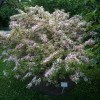
Weigela florida ((Bunge) A.DC.)
1 -
Weigela fujisanensis ((Makino) Nakai)
-
Weigela japonica (Thunb.)
1 -
Weigela maximowiczii ((S.Moore) Rehder)
-
Weigela middendorffiana ((Carrière) K.Koch)
-
Weigela sanguinea ((Nakai) Nakai)
-
Weigela suavis (L.H.Bailey)
-
Weigela subsessilis (L.H.Bailey)