
Genus Hydrangea in Family Hydrangeaceae
In botanical taxonomy, a genus (plural genera) is a rank used to group closely related species within a family. In the hierarchy, genus sits below family and above species.
Genera are defined by shared morphological, anatomical, and genetic characteristics (for example, features of flowers, fruits, seeds, or leaves) that indicate a close evolutionary relationship among the species they contain.
Each genus can include one or more species. Examples include Rosa (roses) and Solanum (nightshades, including tomato and eggplant).
Do you wish to read more about plant taxonomy? Click here!
Genus Description
Suggest a correction!Hydrangea (Gronov.) is a woody genus in the Hydrangeaceae, comprising approximately 70–80 species distributed across temperate to subtropical Asia, with two species native to eastern North America (WFO, 2024; McClintock, 1957). Hydrangea bretschneideri is commonly treated as the type species (McClintock, 1957). The plants are shrubs, subshrubs, or woody climbers with opposite (rarely whorled) leaves that lack stipules; the leaf blades are entire to serrate and often glabrescent with persistent indumentum on the abaxial surfaces. Most species produce broad, convex to flat corymbs or panicles, the inflorescences usually subtended by a small, often early-deciduous epicalyx; the ring of showy, enlarged, usually four-parted sterile flowers can dominate the floral display in many taxa, while the smaller, perfect flowers occupy the interior of the inflorescence. Flowers are actinomorphic, tetramerous with a (0–)4–5-lobed hypanthium, and 4–5 ovate sepals; petals are free, stamens are numerous (c. 10–40) with basally fused filaments in some groups, and the superior to partly inferior ovary is typically 2–5(–6)-carpellate with axile placentation and numerous ovules (McClintock, 1957). The fruit is a loculicidal capsule, and the seeds are small and winged.
Centers of diversity lie in East Asia—Japan, China, and Korea—where endemism is pronounced in mountainous forests at low to mid elevations; several species occur in the Himalayas and Southeast Asia (McClintock, 1957). Typical habitats include moist, shaded forest margins and stream sides; North American representatives occur from the eastern United States to Mexico. Recent phylogenetic work has resolved Asian Hydrangea as a strongly supported clade, with sect. Hydrangea placed outside a larger Asian radiation that includes sect. Aspericodon and sect. Cornidia, aligning with traditional morphological concepts but refining species limits (Hufford et al., 2001; WFO, 2024). Chromosome counts are often reported as x = 36 in horticultural accessions and several Asian taxa, although counts vary and are unevenly sampled across the genus (V顯 et al., 2012). Sterile florets attract pollinators visually, while the central perfect flowers provide pollen and nectar; dispersal is primarily ballistic in the capsule with wind-assisted seed release (McClintock, 1957).
Taxonomically, Hydrangea is currently treated as a single genus encompassing sect. Hydrangea (the horticulturally familiar group), sect. Aspericodon, and sect. Cornidia; previous authors often separated Cornidia at generic rank. The segregate genus Dichroa, sometimes included within Hydrangea, is maintained by most modern treatments (WFO, 2024; Hufford et al., 2001). Subgeneric ranks are optional under the ICN, and circumscriptions continue to be refined with molecular data. In horticulture, hydrangeas are widely cultivated ornamentals for their showy inflorescences and foliage, and common cultivated taxa derive largely from East Asian species; wild species are largely non-weedy and seldom invasive.
Conservation concerns are unevenly documented; many Asian endemics occur in fragmented habitats subject to collection pressure, while North American populations are generally secure. Improved sampling of chromosome numbers, pollination biology, and field-based assessments across the full geographic and taxonomic breadth of Hydrangea would substantially enhance species-level conservation planning (GBIF, 2024).
-
Hydrangea × mizushimarum (H.Ohba)
-
Hydrangea acuminata (Siebold & Zucc.)
3 -
Hydrangea albostellata (Samain, Najarro & E.Martínez)
-
Hydrangea alternifolia (Siebold)
-
Hydrangea amagiana (Makino)
-
Hydrangea amamiohsimensis ((Koidz.) Y.De Smet & C.Granados)
-
Hydrangea ampla ((Chun) Y.De Smet & C.Granados)
-
Hydrangea anomala (D.Don)
-
Hydrangea arborescens (L.)
1 -
Hydrangea arguta ((Gaudich.) Y.De Smet & C.Granados)
-
Hydrangea aspera (Buch.-Ham. ex D.Don)
-
Hydrangea asterolasia (Diels)
-
Hydrangea barbara ((L.) Bernd Schulz)
-
Hydrangea bifida ((Maxim.) Y.De Smet & C.Granados)
-
Hydrangea bretschneideri (Dippel)
-
Hydrangea caerulea ((Stapf) Y.De Smet & C.Granados)
-
Hydrangea chinensis (Maxim.)
4 -
Hydrangea chungii (Rehder)
-
Hydrangea cinerea (Small)
-
Hydrangea coenobialis (Chun)
-
Hydrangea coenotialis (Chun)
-
Hydrangea corylifolia ((Chun) Y.De Smet & C.Granados)
-
Hydrangea crassa ((Hand.-Mazz.) Y.De Smet & C.Granados)
-
Hydrangea daimingshanensis ((Y.C.Wu) Y.De Smet & C.Granados)
-
Hydrangea davidii (Franch.)
-
Hydrangea densifolia ((C.F.Wei) Y.De Smet & C.Granados)
-
Hydrangea diplostemona (Standl.)
-
Hydrangea fauriei ((Hayata) Y.De Smet & C.Granados)
-
Hydrangea febrifuga ((Lour.) Y.De Smet & C.Granados)
-
Hydrangea fistulosa ((G.H.Huang & G.Hao) U.B.Deshmukh & M.B.Shende)
-
Hydrangea glaucescens ((Rehder) Y.De Smet & C.Granados)
-
Hydrangea gracilis (W.T.Wang & M.X.Nie)
-
Hydrangea heteromalla (D.Don)
-
Hydrangea hirsuta ((Gagnep.) Y.De Smet & C.Granados)
-
Hydrangea hirta (Siebold)
-
Hydrangea hwangii (J.M.H.Shaw)
-
Hydrangea hydrangeoides ((Siebold & Zucc.) Bernd Schulz)
4 -
Hydrangea hypoglauca (Rehder)
-
Hydrangea integrifolia (Hayata)
-
Hydrangea involucrata (Siebold)
3 -
Hydrangea jelskii (Szyszył.)
-
Hydrangea kawagoeana (Koidz.)
2 -
Hydrangea kwangsiensis (Hu)
-
Hydrangea kwangtungensis (Merr.)
-
Hydrangea lingii (G.Hoo)
-
Hydrangea linkweiensis (Chun)
-
Hydrangea liukiuensis (Nakai)
-
Hydrangea longifolia (Hayata)
-
Hydrangea longipes (Franch.)
2 -
Hydrangea luteovenosa (Koidz.)
2 -
Hydrangea macrocarpa (Hand.-Mazz.)
-
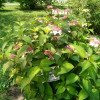
Hydrangea macrophylla ((Thunb.) Ser.)
1 -
Hydrangea mangshanensis (C.F.Wei)
-
Hydrangea marunoi (Tagane & S.Fujii)
-
Hydrangea mathewsii (Briq.)
-
Hydrangea megalocarpa ((Chun) J.M.H.Shaw)
-
Hydrangea minamitanii ((H.Ohba) Yahara)
-
Hydrangea moellendorffi (Hance)
-
Hydrangea mollissima ((Merr.) Y.De Smet & C.Granados)
-
Hydrangea nebulicola (Nevling & Gómez Pompa)
-
Hydrangea obtusifolia ((Hu) Y.De Smet & C.Granados)
-
Hydrangea ofeliae (Sodusta & Lumawag)
-
Hydrangea paniculata (Siebold)
-
Hydrangea peruviana (Moric. ex Ser.)
2 -
Hydrangea petiolaris (Siebold & Zucc.)
-
Hydrangea platyarguta (Y.De Smet & Samain)
-
Hydrangea preslii (Briq.)
-
Hydrangea quercifolia (W.Bartram)
-
Hydrangea radiata (Walter)
-
Hydrangea robusta (Hook.f. & Thomson)
-
Hydrangea sargentiana (Rehder)
-
Hydrangea scandens ((L.f.) Ser.)
-
Hydrangea schizomollis (Y.De Smet & C.Granados)
-
Hydrangea seemannii (L.Riley)
-
Hydrangea serrata ((Thunb.) Ser.)
3 -
Hydrangea serratifolia (F.Phil.)
-
Hydrangea sikokiana (Maxim.)
-
Hydrangea steyermarkii (Standl.)
-
Hydrangea strigosa (Rehder)
-
Hydrangea stylosa (Hook.f. & Thomson)
-
Hydrangea taiwaniana (Y.C.Liu & F.Y.Lu)
-
Hydrangea tarapotensis (Briq.)
-
Hydrangea tomentella ((Hand.-Mazz.) Y.De Smet & C.Granados)
-
Hydrangea versicolor ((Fortune) J.M.H.Shaw)
-
Hydrangea viburnoides ((Hook.f. & Thomson) Y.De Smet & C.Granados)
-
Hydrangea wallichii (J.M.H.Shaw)
-
Hydrangea xanthoneura (Diels)
-
Hydrangea yaoshanensis ((Y.C.Wu) Y.De Smet & C.Granados)
-
Hydrangea ytiensis ((J.M.H.Shaw) J.M.H.Shaw)
-
Hydrangea yunnanensis (Rehder)
-
Hydrangea zhewanensis (P.S.Hsu & X.P.Zhang)