
Genus Ferocactus in Family Cactaceae
In botanical taxonomy, a genus (plural genera) is a rank used to group closely related species within a family. In the hierarchy, genus sits below family and above species.
Genera are defined by shared morphological, anatomical, and genetic characteristics (for example, features of flowers, fruits, seeds, or leaves) that indicate a close evolutionary relationship among the species they contain.
Each genus can include one or more species. Examples include Rosa (roses) and Solanum (nightshades, including tomato and eggplant).
Do you wish to read more about plant taxonomy? Click here!
Genus Description
Suggest a correction!Ferocactus Britton & Rose (Cactaceae) includes about thirty barrel‑shaped species distributed in the Sonoran and Chihuahuan deserts of the southwestern United States and northern–central Mexico. Species richness peaks in Mexico’s Sierra Madre Occidental and Oriental, ranging from sea level to about 2000 m. Ferocactus hamatacanthus (DC.) N.P. Taylor is the type species (Britton & Rose, 1922) and the genus’s acceptance is confirmed by POWO (2024).
Plants are columnar barrels with ten to thirty ribs bearing stout, flattened or hooked spines. A crown of bright, funnel‑shaped flowers opens only in full sun; petals range from yellow to orange. The inferior ovary matures into a fleshy, indehiscent fruit with many glossy seeds; stipules are absent and leaves are reduced to spines, a typical cactaceous trait (Anderson, 2005).
Species richness peaks in Mexico, with F. alamosanus and F. macrodiscus endemic to the Sierra Madre Occidental, while F. acanthodes and F. wislizeni dominate the Sonoran desert and F. hamatacanthus and F. echidne the Chihuahuan desert. Species occur from dunes to limestone outcrops up to 2100 m; many taxa have narrow ranges reflecting Pleistocene vicariance (Hernández‑Ledesma et al., 2015).
Flowers attract diurnal bees and occasionally hummingbirds, indicated by bright corollas. Fruits become soft and brightly coloured at maturity, attracting birds and small mammals that disperse seeds. Chromosome counts consistently show a base number of x = 11, with many diploid taxa at 2n = 22, a pattern typical for Cacteae (Baker & Luebert, 2022).
Molecular studies place Ferocactus in a well‑supported barrel‑cacti clade within Cacteae (Hernández‑Ledesma et al., 2015), informally splitting it into series Ferocactus (stout, flattened spines) and Elephantidens (long, curved spines). Recent revisions synonymised several taxa, e.g., merging F. emoryi with F. perez‑delarosae (Anderson, 2005). Historically some authors merged Ferocactus with Echinocactus (Hunt et al., 2006), but current consensus, reflected in POWO (2024), retains it as distinct.
Several Ferocactus species, especially F. acanthodes and F. hamatacanthus, are cultivated as ornamental barrel cacti in rock gardens and xeriscapes. The fleshy fruits of F. alamosanus are locally harvested for fresh consumption, and mature barrels serve as nurse plants for desert seedlings. No medicinal uses are documented in modern scientific literature.
Habitat loss, illegal collection, and desertification threaten Ferocactus taxa; F. viridescens is Endangered and F. alamosanus Near‑Threatened by the IUCN. Conservation includes ex‑situ seed banking and protected areas, though taxonomic ambiguities limit actions. Phylogenomic work and standardized monitoring will be vital to secure the genus amid future environmental change.
-
Ferocactus acanthodes ((Lem.) Britton & Rose)
4 -
Ferocactus alamosanus ((Britton & Rose) Britton & Rose)
2 -
Ferocactus californicus ((Monv. ex Labour.) Borg)
-
Ferocactus chrysacanthus ((Orcutt) Britton & Rose)
2 -
Ferocactus diguetii ((F.A.C.Weber) Britton & Rose)
-
Ferocactus echidne ((DC.) Britton & Rose)
-
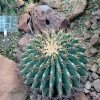
Ferocactus emoryi ((Engelm.) Orcutt)
3 -

Ferocactus flavovirens ((Scheidw.) Britton & Rose)
-
Ferocactus fordii ((Orcutt) Britton & Rose)
2 -
Ferocactus glaucescens ((DC.) Britton & Rose)
-
Ferocactus gracilis (H.E.Gates)
3 -
Ferocactus haematacanthus ((Salm-Dyck) Bravo ex Backeb. & F.M.Knuth)
-
Ferocactus hamatacanthus ((Muehlenpf.) Britton & Rose)
2 -
Ferocactus herrerae (J.G.Ortega)
-
Ferocactus histrix ((DC.) G.E.Linds.)
-
Ferocactus johnstonianus (Britton & Rose)
-
Ferocactus lindsayi (Bravo)
-
Ferocactus macrodiscus ((Mart.) Britton & Rose)
2 -
Ferocactus mathssonii ((Berge ex K.Schum.) N.P.Taylor)
-
Ferocactus peninsulae ((F.A.C.Weber) Britton & Rose)
-
Ferocactus pilifer ((Lem. ex Labour.) G.Unger)
-
Ferocactus pottsii ((Salm-Dyck) Backeb.)
-
Ferocactus recurvus ((Mill.) Borg)
3 -
Ferocactus robustus ((Link & Otto) Britton & Rose)
-
Ferocactus schwarzii (G.E.Linds.)
-
Ferocactus tiburonensis ((G.E.Linds.) Backeb.)
-
Ferocactus townsendianus (Britton & Rose)
-
Ferocactus uncinatus ((Galeotti ex Pfeiff.) Britton & Rose)
-
Ferocactus viridescens ((Torr. & A.Gray) Britton & Rose)
-
Ferocactus wislizeni ((Engelm.) Britton & Rose)