
Genus Santolina in Tribe Anthemideae
In botanical taxonomy, a genus (plural genera) is a rank used to group closely related species within a family. In the hierarchy, genus sits below family and above species.
Genera are defined by shared morphological, anatomical, and genetic characteristics (for example, features of flowers, fruits, seeds, or leaves) that indicate a close evolutionary relationship among the species they contain.
Each genus can include one or more species. Examples include Rosa (roses) and Solanum (nightshades, including tomato and eggplant).
Do you wish to read more about plant taxonomy? Click here!
Genus Description
Suggest a correction!Santolina is a small, primarily western Mediterranean genus in Asteraceae (tribe Anthemideae) comprising about 22 species (POWO, 2024; WFO, 2024). Most are aromatic subshrubs forming low, silvery clumps, but a few are erect perennials. The type species is Santolina chamaecyparissus L. (International Code of Nomenclature for algae, fungi, and plants). Plants typically occupy well-drained, sunlit sites on limestone or siliceous substrates, from coastal dunes and scrub to inland rocky slopes and abandoned fields, most often at low to mid elevations in Mediterranean-type climates.
Diagnostic characters include opposite, decurrent, densely tomentose to lanate leaves that are finely dissected and aromatic, and capitula borne solitary at the ends of branches. The flower heads are discoid with only tubular corollas, inner ones hermaphroditic and peripheral ones pistillate; phyllaries are arranged in two series, and cypsela fruits lack a pappus. Ovary position is inferior, with a single basal ovule per flower. These features align Santolina with other Anthemideae genera and distinguish it from otherwise similar Cytisus (Fabaceae) in overall habit but less in inflorescence.
The principal centers of diversity lie in Iberia and the western Mediterranean, with several taxa restricted to specific mountain systems or islands. Species often occur in dry, open habitats such as garrigue, phrygana, maquis edges, and cultivated margins; some form localized endemics, others are widespread weeds in abandoned agricultural land. Generalist pollinators such as syrphid flies and small bees are recorded, and seeds are likely dispersed by gravity or wind near parent plants in the absence of morphological aids.
Chromosome reports repeatedly document 2n = 18 in multiple species, supporting a base number x = 9 for the genus (Valdés-Bey et al., 1986). Taxonomically, Santolina has been treated as one section (sect. Santolina) by many authors, although sectional frameworks (e.g., Abrotanifolia, Algida) are occasionally applied; current consensus holds that these sections are not consistently supported across studies (APG IV, 2016; M. Anderberg et al., on-line families and genera of vascular plants). Checklist works and regional treatments maintain relatively stable species lists for Iberia and the western Mediterranean, even as some synonymous names persist in local floras (POWO, 2024; WFO, 2024).
Several taxa are common in horticulture, especially Santolina chamaecyparissus and S. rosmarinifolia, valued for drought tolerance, silvery foliage, and long-lasting capitula; some cultivars are used in xeriscapes and low-maintenance plantings. No Santolina species are major timber or grain crops, and the genus is not considered a serious invasive outside of the Mediterranean region. Iberian endemics face threats from habitat conversion and over-collecting, but species richness estimates and distribution maps remain incomplete for several micro-endemics. Continued field surveys and integrative revisions are needed to refine conservation assessments and clarify species limits in the Mediterranean basin.
-
Santolina africana (Jord. & Fourr.)
-
Santolina ageratifolia (bernades ex Asso)
-
Santolina benthamiana (Jord. & Fourr.)
-
Santolina canescens (Lag.)
-
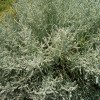
Santolina chamaecyparissus (L.)
-
Santolina corsica (Jord. & Fourr.)
-
Santolina decumbens (Mill.)
-
Santolina elegans (Boiss. ex DC.)
-
Santolina etrusca ((Lacaita) Marchi & D'Amato)
-
Santolina impressa (Hoffmanns. & Link)
-
Santolina insularis ((Gennari ex Fiori) Arrigoni)
-
Santolina ligustica (Arrigoni)
-
Santolina magonica ((O.Bolòs, Molin. & P.Monts.) Romo)
2 -
Santolina melidensis ((Rodr.Oubiña & S.Ortiz) Rodr.Oubiña & S.Ortiz)
-
Santolina neapolitana (Jord. & Fourr.)
-
Santolina oblongifolia (Boiss.)
2 -
Santolina orocarpetana (Riv.-Guerra)
-
Santolina pectinata (Lag.)
1 -
Santolina pinnata (Viv.)
-
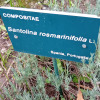
Santolina rosmarinifolia (L.)
4 -
Santolina semidentata (Hoffmanns. & Link)
-
Santolina tincloria (Molina,)
-
Santolina vedranensis ((O.Bolòs & Vigo) L.Sáez, M.Serrano, S.Ortiz & R.Carbajal)
-
Santolina villosa (Mill.)
-
Santolina virens (Mill.)
-
Santolina viscosa (Lag.)