
Genus Lycaste in Family Orchidaceae
In botanical taxonomy, a genus (plural genera) is a rank used to group closely related species within a family. In the hierarchy, genus sits below family and above species.
Genera are defined by shared morphological, anatomical, and genetic characteristics (for example, features of flowers, fruits, seeds, or leaves) that indicate a close evolutionary relationship among the species they contain.
Each genus can include one or more species. Examples include Rosa (roses) and Solanum (nightshades, including tomato and eggplant).
Do you wish to read more about plant taxonomy? Click here!
Genus Description
Suggest a correction!Lycaste is a genus of epiphytic and occasionally lithophytic orchids in the tribe Cymbidieae, subtribe Maxillariaceae (Pridgeon et al., 2001; Chase et al., 2003). It encompasses approximately 30 species distributed from southern Mexico through Central America to the Andes of northern Peru, with centers of diversity in Mexico, Guatemala, and the Cordillera de Talamanca (Oakeley, 2008; POWO, 2024; WFO, 2024). The often-designated type species is L. aromatica (Sw.) Lindl., reflecting early usage under Maxillaria (Pridgeon et al., 2001).
Plants are sympodial with clustered, ovoid to broadly ellipsoid pseudobulbs and three-leaved crowns; leaves are plicate, elliptic to lanceolate, and shed seasonally. Inflorescences arise from the base of new growths and bear one or a few flowers; sepals and petals are typically widely spreading, the dorsal sepal erect to reflexed, the lateral sepals often porrect, and the labellum is usually trilobed with a callus or pair of lamellae at the base (Oakeley, 2008). The column is porrect with a ventral column foot; pollinia are grouped in two waxy masses with a common viscidium. Capsules are fleshy at first, becoming papery at dehiscence, and the seeds are minute and wind-dispersed in the orchid manner (Pridgeon et al., 2001).
Diversity concentrates in upper montane cloud forests and lower montane wet forests from roughly 800 to 1800 m elevation, with several taxa in seasonally dry forests (Oakeley, 2008). Biogeographically the genus follows the Mesoamerican–Northern Andean track, with pronounced local endemism in highland massifs (Pridgeon et al., 2001; Chase et al., 2003).
Pollination is documented for selected species: L. aromatica is pollinated by male euglossine bees in the perfume channel, and other taxa show carrion-associated scents suggesting sapromyiophilous flies or beetles (Oakes Ames, 1922; Dressler, 1993; Oakeley, 2008). Dispersal of seeds is primarily by wind.
Lycaste has been treated either as a small genus distinct from Anguloa, Maxillaria, and Sudamerlycaste or submerged within broader concepts of Maxillaria sensu lato (Pridgeon et al., 2001; Chase et al., 2003). Recent taxonomic treatments maintain Lycaste as a coherent unit (Oakeley, 2008), but detailed subgeneric or sectional subdivisions vary and remain provisional (WFO, 2024). Molecular analyses support the subtribal placement and define Lycaste as part of the core Maxillariinae clade (Chase et al., 2003).
Several species are prized in horticulture for large, fragrant flowers and ease of cultivation in intermediate temperatures; cultivated hybrids have been produced under orchid breeding programs, though stability of cultivars and compatibility vary (Oakeley, 2008). No Lycaste species are significant timber crops, and the genus is not considered invasive (Pridgeon et al., 2001).
Conservation concerns concentrate on habitat loss and overcollection for the trade, but broad-scale threats and population trends remain inadequately quantified (Oakeley, 2008; WFO, 2024). Continued floristic work and standardized IUCN assessments are needed to secure the genus’s long-term status (POWO, 2024).
-
Lycaste × archilae ((Chiron) J.M.H.Shaw)
-
Lycaste × cobani (Oakeley)
-
Lycaste × daniloi (Oakeley)
-
Lycaste × donadrianii (Tinschert ex Oakeley)
-
Lycaste × groganii (E.Cooper)
-
Lycaste × imschootiana (L.Linden & Cogn.)
-
Lycaste × lucianiana (Van Imschoot & Cogn.)
-
Lycaste × niesseniae (Oakeley)
-
Lycaste × panchita (Tinschert ex Oakeley)
-
Lycaste × sandrae (Oakeley)
-
Lycaste × smeeana (Rchb.f.)
-
Lycaste × victoriarum ((Archila & Chiron) J.M.H.Shaw)
-
Lycaste angelae (Oakeley)
-
Lycaste annakamilae (Archila, Szlach. & Chiron)
-
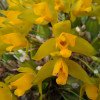
Lycaste aromatica (Lindl.)
-
Lycaste bermudezii ((Archila) J.M.H.Shaw)
-
Lycaste bradeorum (Schltr.)
-
Lycaste brevispatha (Klotzsch ex Rchb.f.)
-
Lycaste bruncana (Bogarín)
-
Lycaste campbellii (C.Schweinf. in I.M.Johnst.)
-
Lycaste chaconii ((Archila) J.M.H.Shaw)
-
Lycaste cochleata (Lindl.)
-
Lycaste consobrina (Rchb.f.)
-
Lycaste crinita (Lindl.)
-
Lycaste cruenta (Lindl.)
-
Lycaste deppei (Lindl.)
-
Lycaste dowiana (Endrés & Rchb.f.)
-
Lycaste fuscina (Oakeley)
-
Lycaste guatemalensis (Archila)
-
Lycaste lasioglossa (Rchb.f.)
-
Lycaste leucantha (Lindl.)
-
Lycaste luminosa (Oakeley)
-
Lycaste macrobulbon (Lindl.)
-
Lycaste macrophylla (Lindl.)
-
Lycaste measuresiana ((B.S.Williams) Oakeley)
-
Lycaste michelii (Oakeley)
-
Lycaste occulta (Oakeley)
-
Lycaste panamanensis ((Fowlie) Archila)
-
Lycaste powellii (Schltr.)
-
Lycaste puntarenasensis ((Fowlie) Archila)
-
Lycaste schilleriana (Rchb.f.)
-
Lycaste sebastianii (Archila)
-
Lycaste suaveolens (Summerh. in Curtis)
-
Lycaste tricolor (Rchb.f.)
-
Lycaste virginalis ((Scheidw.) Linden)
-
Lycaste viridescens ((Oakeley) Oakeley)
-
Lycaste xanthocheila ((Fowlie) Archila)
-
Lycaste xytriophora (Linden & Rchb.f.)
-
Lycaste zacapensis (Archila)