
Genus Beaucarnea in Family Asparagaceae
In botanical taxonomy, a genus (plural genera) is a rank used to group closely related species within a family. In the hierarchy, genus sits below family and above species.
Genera are defined by shared morphological, anatomical, and genetic characteristics (for example, features of flowers, fruits, seeds, or leaves) that indicate a close evolutionary relationship among the species they contain.
Each genus can include one or more species. Examples include Rosa (roses) and Solanum (nightshades, including tomato and eggplant).
Do you wish to read more about plant taxonomy? Click here!
Genus Description
Suggest a correction!Beaucarnea (Lem.) Lem. is a small tree and shrub genus in the Ruscaceae subfamily Nolinoideae, most commonly placed there following modern Angiosperm classifications that absorbed Agavaceae within Asparagaceae (APG IV, 2016; WFO, 2024). About a dozen species are accepted by global services, with new taxa continuing to be described; the group is native to semi-arid to seasonally dry forests, scrub, and thornlands from the Chihuahuan and Yucatán regions through Central America to Belize (POWO, 2024; WFO, 2024). Its perennial caudex-swollen habit and narrow, evergreen leaves with serrate margins readily distinguish it in Nolinoideae; species range from multitrunked shrubs to small trees reaching several meters, often retaining withered leaf bases along the trunk. Inflorescences are terminal panicles or racemes bearing minute, dioecious, apetalous flowers with reduced, hyaline tepals; the fruit is a small, often indehiscent capsule with wingless seeds (Bogler et al., 2006). These traits collectively define a genus easily recognized in the field and in mixed collections.
Species richness concentrates in Mexico, with several narrowly endemic taxa in Oaxaca and the Tehuacán–Cuicatlán region; other taxa extend through dry belts of Veracruz, Chiapas, and the Yucatán Peninsula and into Guatemala and Belize (POWO, 2024; WFO, 2024). Typical habitats include limestone soils, canyon slopes, and cloud margins, generally below montane cloud belts; regional distributions often track ancient biotic corridors formed during Pleistocene aridity cycles. Pollination and seed dispersal remain poorly documented for most taxa; reports suggest generalist wind pollination is plausible given minute flowers and open panicles, while fruits appear adapted for short-distance gravity movement rather than long-range dispersal. Chromosome counts are reported for some species at 2n = 38, implying a base number of x = 19 (Bogler et al., 2006), but comprehensive surveys across the genus are lacking.
Taxon delimitation and rank have been debated; some authors treat Beaucarnea as a subgenus or section within Nolina (e.g., Nolina subg. Beaucarnea; T. K. Sprague in Hutchinson, 1942), while current taxonomic backbones recognize Beaucarnea at generic level (POWO, 2024; WFO, 2024). Modern phylogenetic work situates Beaucarnea within Nolinoideae, supporting its distinctness from Dasylirion and allied genera (Hernández-Ledesma et al., 2015; APG IV, 2016), yet precise species limits and synonymy remain unsettled in several Mexican centers of diversity.
The genus is widely grown in horticulture, especially Beaucarnea recurvata (often cited as Nolina recurvata in horticultural literature), appreciated as a drought-tolerant architectural specimen for interiors, xeriscapes, and retail markets; some species are collected in the wild and moved into the ornamental trade. No Beaucarnea species are significant crops or timbers.
Conservation outlook is mixed: habitat loss, collection pressure, and ongoing taxonomic confusion impede conservation planning (Hernández-Ledesma et al., 2015). Renewed integrative revisions and standardized assessments are needed to stabilize taxonomy and guide targeted protection of narrowly endemic species in rapidly developing regions.
-
Beaucarnea compacta (L.Hern. & Zamudio)
-
Beaucarnea glassiana ((L.Hern. & Zamudio) V.Rojas-Piña)
-
Beaucarnea goldmanii (Rose)
-
Beaucarnea gracilis (Lem.)
-
Beaucarnea guatemalensis (Rose)
-
Beaucarnea hiriartiae (L.Hern.)
-
Beaucarnea hookeri ((Lem.) Baker)
-
Beaucarnea pliabilis ((Baker) Rose)
-
Beaucarnea purpusii (Rose)
-
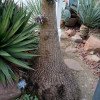
Beaucarnea recurvata ((K.Koch & Fintelm.) Lem.)
-
Beaucarnea sanctomariana (L.Hern.)
-
Beaucarnea stricta ((K.Koch & Fintelm.) Lem.)