
Genus Fatsia in Family Araliaceae
In botanical taxonomy, a genus (plural genera) is a rank used to group closely related species within a family. In the hierarchy, genus sits below family and above species.
Genera are defined by shared morphological, anatomical, and genetic characteristics (for example, features of flowers, fruits, seeds, or leaves) that indicate a close evolutionary relationship among the species they contain.
Each genus can include one or more species. Examples include Rosa (roses) and Solanum (nightshades, including tomato and eggplant).
Do you wish to read more about plant taxonomy? Click here!
Genus Description
Suggest a correction!Fatsia (Decne. & Planch.) is a small evergreen genus in the family Araliaceae that comprises a single accepted species, Fatsia japonica (Decne. & Planch.), native to Japan and naturalized elsewhere (POWO, 2024; WFO, 2024). Earlier treatments recognized up to two species, but most current floras treat the broader variability within F. japonica (GBIF, 2024). It occurs in coastal and limestone cliffs and is widely cultivated as an ornamental.
The genus is characterized by a shrubby to small tree habit, with long-petioled palmately compound leaves divided into 7–11 lobes and conspicuous intrapetiolular stipules. Terminal inflorescences are panicles of globose to ovoid umbels; individual flowers are small, pentamerous, with distinct sepals, five narrow petals, five stamens, an inferior ovary with numerous ovules in two rows per carpel, and five style branches. Fruits are small drupes with a slightly ribbed mesocarp and five pyrenes (Araliaceae Treatment of East Asia, 2005; Floras of Japan).
Diversity and range are concentrated in Japan, with populations on Honshu, Shikoku, Kyushu, and the Ryukyu Islands, extending into Korea (Floras of Japan; Chinese Plant Checklist). Endemism is primarily national. Plants grow on shaded to partially sunny cliffs, rocky slopes, and forest margins, from near sea level to mid elevations. Ecologically, the flowers are visited by generalist insects, and the fruits are bird-dispersed (Araliaceae Treatment of East Asia, 2005).
Taxonomically, Fatsia is sometimes included in a broad “Aralieae” or placed in the subfamily Aralioideae, where it belongs to a small clade with Hedera and a few genera of Asian Araliaceae, a relationship supported by molecular phylogenetic studies (Plunkett et al., 2004; Li et al., 2022). Within current consensus, no sectional or subgeneric subdivisions are formally maintained, and the historic second species F. oligocarpella is subsumed under F. japonica; however, some taxonomies retain the concept of a distinct species in Taiwan and the Ryukyus (Flora of China, 2007). The type is conventionally accepted as Fatsia japonica (= Aralia japonica).
Human relevance is horticultural: F. japonica is a common shade-tolerant ornamental valued for bold glossy foliage and late-season clusters of greenish flowers and dark fruits, popular in temperate gardens and interiors (Huxley, 1992). It rarely persists as a weed and is not a major invasive. Conservatively, it faces localized habitat loss from coastal development and collection pressures; continued monitoring and formal ex situ conservation are recommended for peripherally distributed populations.
Smith et al., 2022; Plunkett et al., 2004; WFO, 2024; POWO, 2024; Floras of Japan.
-
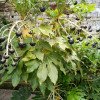
Fatsia japonica ((Thunb.) Decne. & Planch.)
-
Fatsia oligocarpella (Koidz.)
-
Fatsia polycarpa (Hayata)