
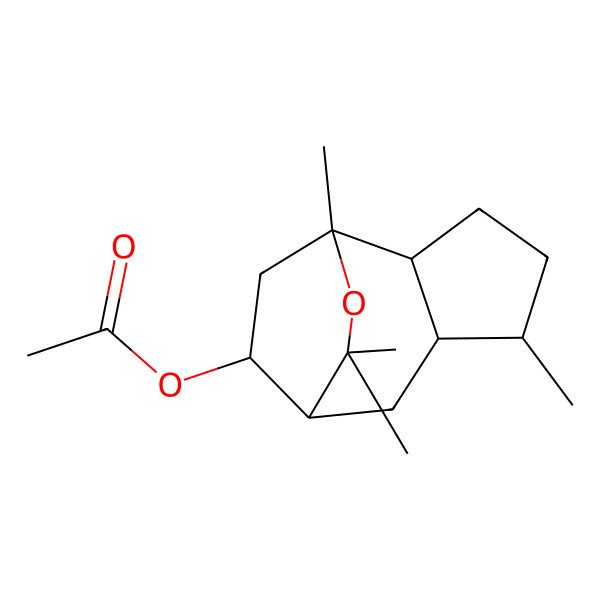
Kessanyl acetate
| Internal ID | 26d6cd17-5203-42cd-8f9a-c3432226d48f |
| Taxonomy | Organoheterocyclic compounds > Oxepanes |
| IUPAC Name | (1,5,9,9-tetramethyl-10-oxatricyclo[6.2.2.02,6]dodecan-12-yl) acetate |
| SMILES (Canonical) | CC1CCC2C1CC3C(CC2(OC3(C)C)C)OC(=O)C |
| SMILES (Isomeric) | CC1CCC2C1CC3C(CC2(OC3(C)C)C)OC(=O)C |
| InChI | InChI=1S/C17H28O3/c1-10-6-7-13-12(10)8-14-15(19-11(2)18)9-17(13,5)20-16(14,3)4/h10,12-15H,6-9H2,1-5H3 |
| InChI Key | CGBOQYJQRLRGIE-UHFFFAOYSA-N |
| Popularity | 0 references in papers |
| Molecular Formula | C17H28O3 |
| Molecular Weight | 280.40 g/mol |
| Exact Mass | 280.20384475 g/mol |
| Topological Polar Surface Area (TPSA) | 35.50 Ų |
| XlogP | 3.40 |
| Kessanol, acetate |
| CGBOQYJQRLRGIE-UHFFFAOYSA-N |
| 4.beta.H,5.beta.,10.beta.H-Guaian-8.alpha.-ol, 10,11-epoxy-, acetate |
| (1R,3aR,4S,6S,7S,8aR)-1,4,9,9-Tetramethyldecahydro-4,7-(epoxymethano)azulen-6-yl acetate |
| 1,4-Ethano-1H-cyclopent[c]oxepin-9-ol, octahydro-1,3,3,6-tetramethyl-, 9-acetate, (1S,4S,5aR,6R,8aR,9S)- |
| 1,4-Ethano-1H-cyclopent[c]oxepin-9-ol, octahydro-1,3,3,6-tetramethyl-, acetate, (1S,4S,5aR,6R,8aR,9S)- |
| 1,4-Ethano-1H-cyclopent[c]oxepin-9-ol, octahydro-1,3,3,6-tetramethyl-, acetate, [1S-(1.alpha.,4.alpha.,5a.beta.,6.alpha.,8a.alpha.,9R*)]- |
| Target | Value | Probability (raw) | Probability (%) |
|---|---|---|---|
| No predicted properties yet! | |||
Proven Targets:
| CHEMBL ID | UniProt ID | Name | Min activity | Assay type | Source |
|---|---|---|---|---|---|
| No proven targets yet! | |||||
Predicted Targets (via Super-PRED):
| CHEMBL ID | UniProt ID | Name | Probability | Model accuracy |
|---|---|---|---|---|
| CHEMBL3251 | P19838 | Nuclear factor NF-kappa-B p105 subunit | 96.22% | 96.09% |
| CHEMBL5619 | P27695 | DNA-(apurinic or apyrimidinic site) lyase | 94.85% | 91.11% |
| CHEMBL4481 | P35228 | Nitric oxide synthase, inducible | 93.24% | 94.80% |
| CHEMBL340 | P08684 | Cytochrome P450 3A4 | 92.28% | 91.19% |
| CHEMBL4261 | Q16665 | Hypoxia-inducible factor 1 alpha | 89.13% | 85.14% |
| CHEMBL3137262 | O60341 | LSD1/CoREST complex | 88.08% | 97.09% |
| CHEMBL1994 | P08235 | Mineralocorticoid receptor | 85.90% | 100.00% |
| CHEMBL241 | Q14432 | Phosphodiesterase 3A | 84.44% | 92.94% |
| CHEMBL4303 | P08238 | Heat shock protein HSP 90-beta | 84.11% | 96.77% |
| CHEMBL4793 | Q86TI2 | Dipeptidyl peptidase IX | 83.94% | 96.95% |
| CHEMBL3267 | P48736 | PI3-kinase p110-gamma subunit | 82.38% | 95.71% |
| CHEMBL4040 | P28482 | MAP kinase ERK2 | 80.94% | 83.82% |
| CHEMBL1907603 | Q05586 | Glutamate NMDA receptor; GRIN1/GRIN2B | 80.92% | 95.89% |
| CHEMBL4478 | Q00975 | Voltage-gated N-type calcium channel alpha-1B subunit | 80.24% | 97.14% |
| CHEMBL5255 | O00206 | Toll-like receptor 4 | 80.18% | 92.50% |
| CHEMBL1293249 | Q13887 | Kruppel-like factor 5 | 80.02% | 86.33% |
Below are displayed all the plants proven (via scientific papers) to contain this
compound!
To see more specific details click the taxa you are interested in.
To see more specific details click the taxa you are interested in.
| Valeriana officinalis |
| PubChem | 527492 |
| LOTUS | LTS0084522 |
| wikiData | Q104957438 |