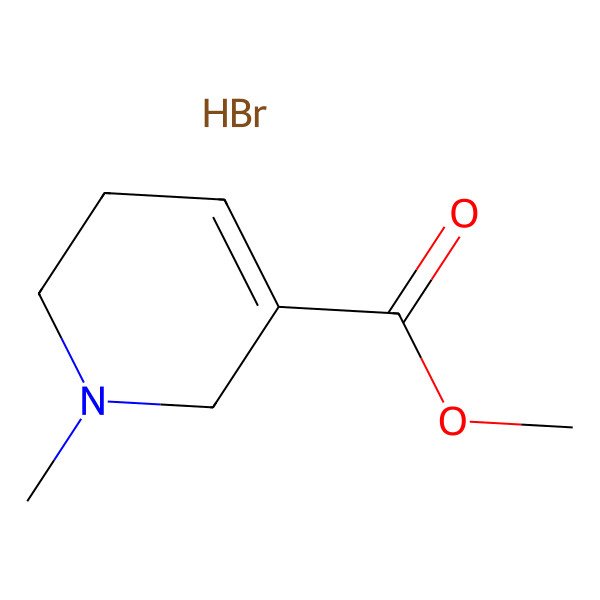
| 300-08-3 |
| ARECOLINE HBr |
| NSC-31750 |
| 24S79B9CX7 |
| DTXSID9075379 |
| 3-Pyridinecarboxylic acid, 1,2,5,6-tetrahydro-1-methyl-, methyl ester, hydrobromide |
| RefChem:113811 |
| DTXCID6038112 |
| 206-087-3 |
| methyl 1-methyl-1,2,3,6-tetrahydropyridin-1-ium-5-carboxylate;bromide |
| Arecoline bromide |
| Methyl 1-Methyl-1,2,5,6-tetrahydropyridine-3-carboxylate hydrobromide |
| MFCD00039041 |
| Esterase |
| Arecoline (hydrobromide) |
| 3-Pyridinecarboxylicacid, 1,2,5,6-tetrahydro-1-methyl-, methyl ester, hydrobromide |
| methyl 1-methyl-3,6-dihydro-2H-pyridine-5-carboxylate,hydrobromide |
| MLS000028840 |
| Arekolinhydrobromid |
| Arekolinhydrobromid [German] |
| NSC31750 |
| SR-01000075307 |
| SMR000058258 |
| EINECS 206-087-3 |
| NSC 31750 |
| Arecoline hydrobromide [NF] |
| UNII-24S79B9CX7 |
| methyl 1-methyl-1,2,5,6-tetrahydropyridine-3-carboxylate, bromide |
| Prestwick_958 |
| methyl 1-methyl-3,6-dihydro-2H-pyridine-5-carboxylate;hydrobromide |
| methyl 1,2,5,6-tetrahydro-1-methylnicotinate hydrobromide |
| Methyl N-methyl-1,2,5,6-tetrahydronicotinate hydrobromide |
| N-Methyltetrahydronicotinic acid methyl ester hydrobromide |
| Methyl 1,2,5,6-tetrahydro-1-methylnicotinate, hydrobromide |
| methyl 1-methyl-3,6-dihydro-2H-pyridine-5-carboxylate hydrobromide |
| MLS002222282 |
| ARECOLINE, HYDROBROMIDE |
| SCHEMBL527735 |
| SPECTRUM1500680 |
| CHEMBL449209 |
| orb1306134 |
| MSK40378H |
| CHEBI:233150 |
| HMS1569A06 |
| HMS1921C10 |
| HMS5081P11 |
| Pharmakon1600-01500680 |
| ARECOLINE HYDROBROMIDE [MI] |
| BCP02923 |
| HY-B0489 |
| Tox21_500049 |
| CCG-38354 |
| NSC757418 |
| s2614 |
| SBB053837 |
| AKOS009031332 |
| AC-8048 |
| BCP9000314 |
| FA17972 |
| LP00049 |
| NSC-757418 |
| PS-7647 |
| NICOTINIC ACID, 1,2,5,6-TETRAHYDRO-1-METHYL-, METHYL ESTER, HYDROBROMIDE |
| WLN: T6N CUTJ A1 CVO1 & GH |
| NCGC00093563-01 |
| NCGC00093563-02 |
| NCGC00093563-03 |
| NCGC00093563-04 |
| NCGC00093563-05 |
| NCGC00093563-06 |
| NCGC00260734-01 |
| SY057191 |
| BCP0726000295 |
| QT2275000 |
| A0523 |
| EU-0100049 |
| NS00079747 |
| ST50307303 |
| SW197045-3 |
| EN300-21253 |
| A 6134 |
| A10820 |
| SR-01000075307-1 |
| SR-01000075307-3 |
| SR-01000075307-8 |
| Q27253878 |
| SR-01000075307-10 |
| SR-01000075307-11 |
| Methyl N-methyl-1,5,6-tetrahydronicotinate hydrobromide |
| Z104494834 |
| Arecoline hydrobromide, VETRANAL(TM), analytical standard |
| Methyl 1,5,6-tetrahydro-1-methylnicotinate, hydrobromide |
| Nicotinic acid,2,5,6-tetrahydro-1-methyl-, methyl ester, hydrobromide |
| 1-Methyl-1,2,5,6-tetrahydro-3-pyridinecarboxylic acid methyl ester hydrobromide |
| 3-Pyridinecarboxylic acid,2,5,6-tetrahydro-1-methyl-, methyl ester, hydrobromide |
| 1,2,5,6-Tetrahydro-1-methyl-3-pyridinecarboxylic acid methyl ester hydrobromide;1-Methyl-1,2,5,6-tetrahydro-pyridine-3-carboxylic ac id methyl ester hydrobromide;Arecaidine methyl ester hydrobromide;METHYL 1,2,5,6-TETRAHYDRO-1-METHYL-3-PYRIDINECARBOXY |
| 9016-18-6 |
|
There are more than 10 synonyms. If you wish to see them all click here.
|