
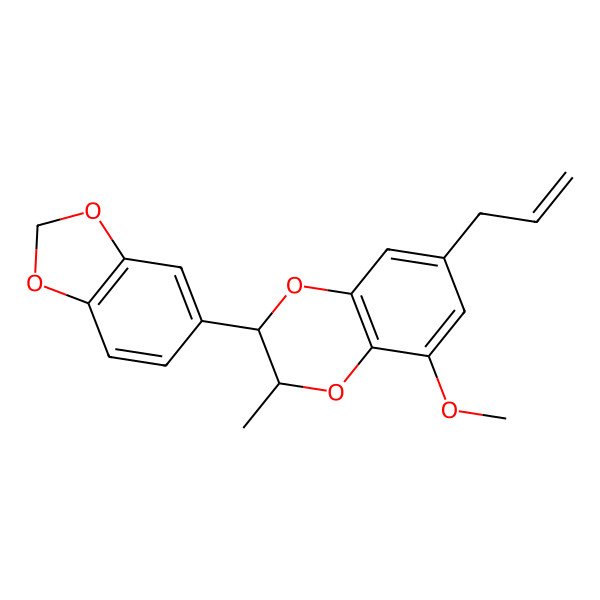
(2R,3R)-2-(1,3-benzodioxol-5-yl)-5-methoxy-3-methyl-7-prop-2-enyl-2,3-dihydro-1,4-benzodioxine
| Internal ID | c655b9fa-4849-4065-8649-5b99ffbf8ac4 |
| Taxonomy | Organoheterocyclic compounds > Benzodioxanes > Benzo-1,4-dioxanes |
| IUPAC Name | (2R,3R)-2-(1,3-benzodioxol-5-yl)-5-methoxy-3-methyl-7-prop-2-enyl-2,3-dihydro-1,4-benzodioxine |
| SMILES (Canonical) | |
| SMILES (Isomeric) | |
| InChI | InChI=1S/C20H20O5/c1-4-5-13-8-17(21-3)20-18(9-13)25-19(12(2)24-20)14-6-7-15-16(10-14)23-11-22-15/h4,6-10,12,19H,1,5,11H2,2-3H3/t12-,19+/m1/s1 |
| InChI Key | ZWXZTOYXYBPRJT-BLVKFPJESA-N |
| Popularity | 3 references in papers |
| Molecular Formula | C20H20O5 |
| Molecular Weight | 340.40 g/mol |
| Exact Mass | 340.13107373 g/mol |
| Topological Polar Surface Area (TPSA) | 46.20 Ų |
| XlogP | 4.50 |
| There are no found synonyms. |
| Target | Value | Probability (raw) | Probability (%) |
|---|---|---|---|
| No predicted properties yet! | |||
Proven Targets:
| CHEMBL ID | UniProt ID | Name | Min activity | Assay type | Source |
|---|---|---|---|---|---|
| No proven targets yet! | |||||
Predicted Targets (via Super-PRED):
| CHEMBL ID | UniProt ID | Name | Probability | Model accuracy |
|---|---|---|---|---|
| CHEMBL240 | Q12809 | HERG | 99.53% | 89.76% |
| CHEMBL5619 | P27695 | DNA-(apurinic or apyrimidinic site) lyase | 96.79% | 91.11% |
| CHEMBL3251 | P19838 | Nuclear factor NF-kappa-B p105 subunit | 95.98% | 96.09% |
| CHEMBL1293249 | Q13887 | Kruppel-like factor 5 | 93.81% | 86.33% |
| CHEMBL4203 | Q9HAZ1 | Dual specificity protein kinase CLK4 | 91.52% | 94.45% |
| CHEMBL2373 | P21730 | C5a anaphylatoxin chemotactic receptor | 91.39% | 92.62% |
| CHEMBL3137262 | O60341 | LSD1/CoREST complex | 90.13% | 97.09% |
| CHEMBL4481 | P35228 | Nitric oxide synthase, inducible | 90.05% | 94.80% |
| CHEMBL3108638 | O15164 | Transcription intermediary factor 1-alpha | 88.29% | 95.56% |
| CHEMBL4261 | Q16665 | Hypoxia-inducible factor 1 alpha | 87.05% | 85.14% |
| CHEMBL5697 | Q9GZT9 | Egl nine homolog 1 | 86.70% | 93.40% |
| CHEMBL2581 | P07339 | Cathepsin D | 86.04% | 98.95% |
| CHEMBL5311 | P37023 | Serine/threonine-protein kinase receptor R3 | 85.58% | 82.67% |
| CHEMBL225 | P28335 | Serotonin 2c (5-HT2c) receptor | 84.36% | 89.62% |
| CHEMBL3060 | Q9Y345 | Glycine transporter 2 | 83.90% | 99.17% |
| CHEMBL1907603 | Q05586 | Glutamate NMDA receptor; GRIN1/GRIN2B | 83.76% | 95.89% |
| CHEMBL5608 | Q16288 | NT-3 growth factor receptor | 83.30% | 95.89% |
| CHEMBL335 | P18031 | Protein-tyrosine phosphatase 1B | 83.24% | 95.17% |
| CHEMBL1966 | Q02127 | Dihydroorotate dehydrogenase | 83.14% | 96.09% |
| CHEMBL4478 | Q00975 | Voltage-gated N-type calcium channel alpha-1B subunit | 82.17% | 97.14% |
| CHEMBL3091268 | Q92753 | Nuclear receptor ROR-beta | 81.74% | 95.50% |
| CHEMBL1075094 | Q16236 | Nuclear factor erythroid 2-related factor 2 | 80.47% | 96.00% |
| CHEMBL264 | Q9Y5N1 | Histamine H3 receptor | 80.24% | 91.43% |
| CHEMBL2413 | P32246 | C-C chemokine receptor type 1 | 80.01% | 89.50% |
Below are displayed all the plants proven (via scientific papers) to contain this
compound!
To see more specific details click the taxa you are interested in.
To see more specific details click the taxa you are interested in.
| Licaria chrysophylla |
| PubChem | 102306413 |
| LOTUS | LTS0081353 |
| wikiData | Q105385313 |